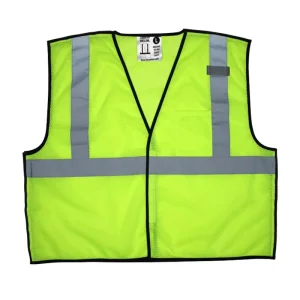
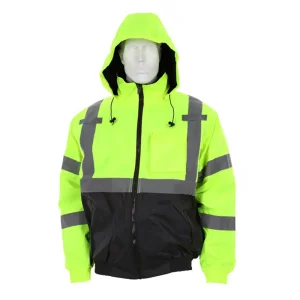
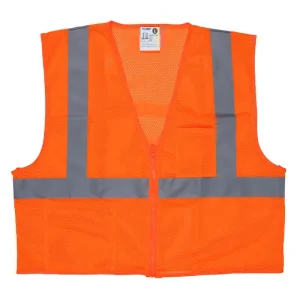
Certified high-visibility apparel engineered for emergency response units, tactical medical personnel, and industrial safety compliance.

Analysis of international emergency services procurement demand, regulatory shifts toward ANSI/ISEA 107-2020 Type P compliance, and modern manufacturing innovations.
Unlike standard construction vests, an EMS Safety Vest serves as a specialized operational interface for paramedics, emergency medical technicians (EMTs), and disaster response personnel. Operatives deployed to highway collision zones, urban disaster sites, and low-light incident command areas require garment functionality that extends beyond simple visual presence.
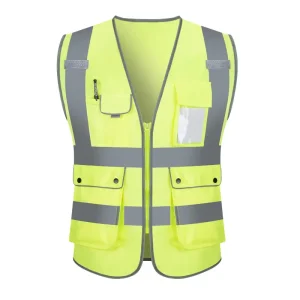
High-visibility EMS apparel combines extreme optical reflectivity with ergonomic utility—featuring integrated radio/mic tabs, clear ID card windows for rapid chain-of-command verification, universal shear holsters, and blood-borne pathogen protective finishes. Identifying a certified wholesale EMS safety vest supplier ensures that your inventory adheres strictly to international life-safety protocols.
The global public safety apparel landscape is undergoing significant regulatory updates. The ANSI/ISEA 107-2020 revision introduced clear segmentations between Type R (Roadway), Type O (Off-Roadway), and Type P (Public Safety) garments. Type P vests specifically address emergency responders, requiring shorter garment lengths for immediate belt-access to medical sidearms or trauma kits, combined with mandatory 5-point breakaway points.
European standards (EN ISO 20471:2013+A1:2016) similarly enforce photometric testing after multiple wash cycles, ensuring that retroreflective micro-bead matrices retain superior luminance performance even under heavy industrial laundering regimes.
A detailed comparative standard matrix designed for government procurement directors, institutional buyers, and safety apparel distributors.
| Standard Classification | Target Operational Intent | Min. Fluorescent Base Fabric | Min. Retroreflective Material | Key Ergonomic Features Required |
|---|---|---|---|---|
| ANSI/ISEA 107-2020 Type P Class 2 | Emergency Medical, Fire Service, Law Enforcement | 450 sq. inches (0.29 m²) | 201 sq. inches (0.13 m²) | 5-Point Breakaway, Duty Belt Clearance, Mic Loops, Radio Pockets |
| ANSI/ISEA 107-2020 Type P Class 3 | High-Speed Highway EMS, Inclement Weather EMT | 770 sq. inches (0.50 m²) | 310 sq. inches (0.20 m²) | Full Sleeve Reflective Coverage, Waterproof Membrane, ID Window |
| EN ISO 20471 Class 2 | European Emergency First Responders | 0.50 m² | 0.13 m² | 360° Horizontal Banding, High-Contrast Fluorescent Yellow/Green/Orange |
| EN ISO 20471 Class 3 | Extreme Risk / Night Trauma Medical Response | 0.80 m² | 0.20 m² | Torso & Limb Surrounding Bands, Minimum Micro-Prismatic Coefficient > 330 cd/lx |
Retroreflectivity in commercial safety vests relies on either Glass Bead Technology or Micro-Prismatic Micro-Structure Polymers. Glass bead arrays offer wide-angle reflectivity, while micro-prismatic tapes (such as 3M™ Scotchlite™ or Reflexite® style arrays) bounce light directly back to the driver's eye line with over 500 cd/lx·m² initial luminance. For specialized EMS operations near active traffic corridors, micro-prismatic tape provides up to 300% greater daytime visual pop when paired with high-gloss fluorescent backing borders.
Why sourcing directly from specialized China manufacturing hubs delivers unmatched scalability, strict quality assurance, and aggressive cost advantages.
Located within China's premier safety equipment and hardware industrial zone (Yongkang, Zhejiang), our facilities leverage immediate proximity to raw material textile mills, specialized reflective film producers, dye houses, and custom hardware injection molders. This tight-knit ecosystem eliminates lead-time friction, enabling rapid procurement of flame-retardant mesh, anti-static polyesters, and specialized high-tensile hook-and-loop fasteners.
Modern EMS safety vest production relies on automated laser-cutting systems to maintain exact panel dimensions required for consistent ANSI sizing. Automated pattern laying reduces fabric waste by up to 14%, directly lowering unit costs for bulk purchasers. Furthermore, ultrasonic welding techniques are utilized on waterproof rainwear seams to guarantee zero fluid penetration during severe storm deployments.
Every production lot undergoes rigorous internal quality inspection before shipment. Spectrophotometers measure baseline chromaticity coordinates for fluorescent yellow and orange dyes. Retroreflectometers verify tape candlepower ratings ($R_A \ge 330 \text{ cd/lx}\cdot\text{m}^2$). Tensile testing rigs test seam strength and breakaway velcro release thresholds to ensure life-safety dependability in emergency operations.
Tailored design configurations optimized for specific tactical operational environments and first responder roles.
Operational Risk: High-speed vehicle impact, zero ambient illumination, secondary vehicle collisions.
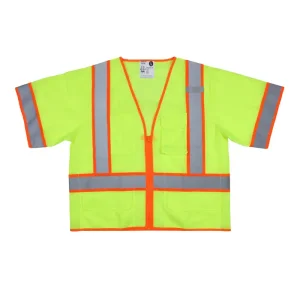
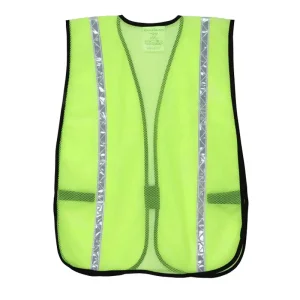
Garment Spec: ANSI Class 3 or Class 2 Type P vest featuring 360-degree high-contrast lime-green fluorescent mesh, 2-inch wide micro-prismatic silver reflective tape with contrasting 4-inch orange border trim. Includes 5-point breakaway points at shoulders, sides, and front closure to prevent snagging on twisted wreckage.
Operational Risk: Chain-of-command confusion, multi-agency congestion, hazardous fluid exposure.
Garment Spec: Customized color-coded EMS vests (Royal Blue for Medical Triage, Green for Command, Red for Logistics). Features clear PVC chest and back sleeves for removable laminated title cards ("EMS COMMAND", "PARAMEDIC", "TRIAGE OFFICER"), dual radio keeper tabs, and fluid-repellent Teflon-coated polyester weaves.
Operational Risk: Severe rain, hypothermia, low visibility in heavy foliage or snow.
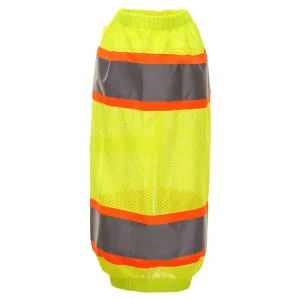
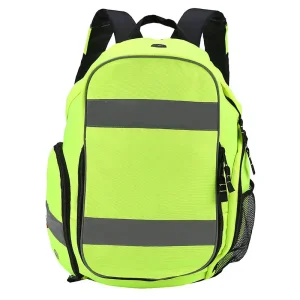
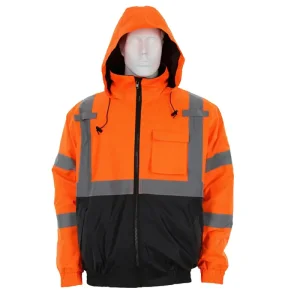
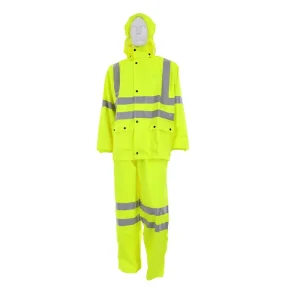
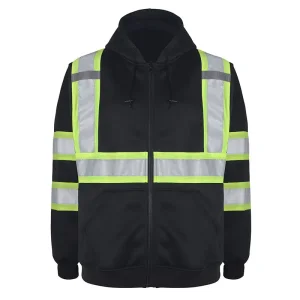
Garment Spec: High-visibility waterproof PU-coated breathable rain jackets and insulated Class 3 parkas. Engineered with storm flaps, fleece-lined collars, drop-down tactical tail panels, and heavy-duty storm-resistant zips designed to interface seamlessly with leg gaiters and safety backpacks.
Emerging technologies transforming high-visibility apparel into intelligent, active protective equipment.
Passive retroreflective tape relies on external vehicle headlights to reflect light. Next-generation EMS safety vests incorporate ultra-thin, flexible LED optic strip loops powered by rechargeable lithium-polymer battery packs. Operating in steady-on or high-frequency strobing modes, these active systems ensure first responders are visible from up to 1,000 meters away, even in total dark environments without ambient light sources.
With global municipal procurement contracts prioritizing ESG (Environmental, Social, and Governance) targets, wholesale manufacturers are shifting toward GRS-certified (Global Recycled Standard) recycled polyester (rPET) spun from post-consumer plastic bottles. Advanced eco-dyes match original fluorescent chromaticity requirements without emitting hazardous VOCs during manufacture.
Experimental EMS apparel features embedded conductive yarns and micro-sensors capable of measuring ambient temperature, toxic gas concentrations (such as carbon monoxide), and vital signs of emergency crews. Data is relayed via low-power Bluetooth to mobile incident command stations, ensuring real-time responder health monitoring during hazardous deployments.
A step-by-step framework for wholesale importers, safety equipment distributors, and government procurement teams evaluating EMS supplier capabilities.
Ensure that prospective suppliers provide third-party accredited lab certificates (such as SATRA, SGS, or UL) proving compliance with ANSI/ISEA 107-2020 and EN ISO 20471. Validate test reports specifically for baseline fabric chromaticity, tear strength, and retroreflective performance after 25 to 50 wash cycles.
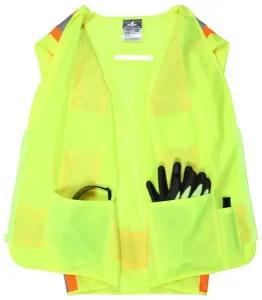
Demand tailored options such as specialized pocketing (tablet pockets, trauma shears loops, dual mic tabs), reinforced stitching at stress points, custom screen-printed heat-transfer reflective logos, and adjustable side straps for winter coat layering adaptability.
Evaluate factory capacity, monthly output limits (e.g., 200,000+ units/month), minimum order quantity (MOQ) flexibilities, and OEM sample turnaround times (typically 3 to 7 working days). Confirm compliance with ISO 9001 quality management standards.
Detailed answers to technical, regulatory, and commercial sourcing queries for wholesale safety gear buyers.
A standard safety vest is primarily designed for basic visual identification on construction sites. An EMS Safety Vest is built to ANSI/ISEA 107-2020 Type P (Public Safety) standards, featuring short lengths for quick belt/gear access, 5-point breakaway points to prevent entanglement in machinery or vehicle wreckage, specialized radio pockets, mic loops, clear ID windows, and fluid-repellent chemical treatments.
The 5-point breakaway system uses heavy-duty hook-and-loop fasteners at the shoulders (2), sides (2), and front closure (1). If a paramedic or officer is grabbed by a hostile individual or caught on moving vehicle parts, the vest detaches instantly from the wearer's body under load, preventing severe injury or entrapment.
High-visibility garments are tested under ISO 6330 or AATCC laundering procedures. High-quality micro-prismatic and glass bead reflective tapes supplied by certified Chinese factories maintain their photometric performance ($R_A \ge 100 \text{ cd/lx}\cdot\text{m}^2$) for 25 to 50 industrial wash cycles at 40°C or 60°C.
Yes. Direct factory suppliers offer comprehensive OEM/ODM services including silk-screen printing, reflective heat-transfer transfers, custom woven badges, Pantone-matched background fabrics (e.g., EMS Blue, High-Vis Green, Crimson Red), and customized pocket layouts according to tender specifications.
Standard MOQs typically start at 500 to 1,000 units per style for customized garments, while in-stock blank models can be ordered in smaller quantities. Prototype samples are produced in 3 to 7 working days, with full container bulk production completed within 20 to 35 days.
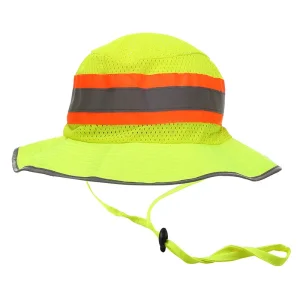
Complete your safety equipment offerings with our line of protective jackets, rainwear, headwear, and specialty reflective items.