1. Executive Overview & Global Market Dynamics for Hi-Vis Safety Shirts
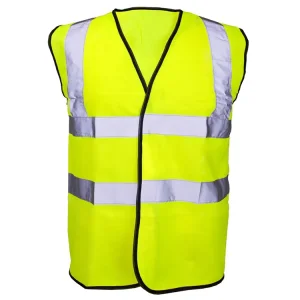
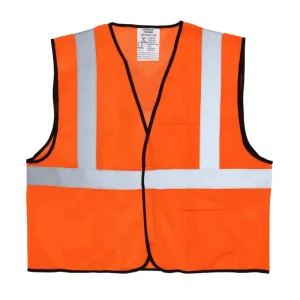
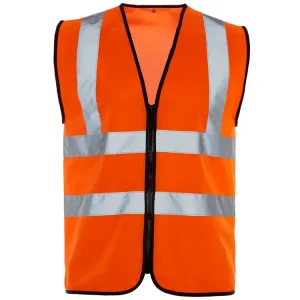
The global industrial personal protective equipment (PPE) sector is undergoing a profound paradigm shift driven by stringent occupational safety regulations, expanding infrastructure developments, and heightened awareness of workplace ergonomics. Within this market, the demand for Hi-Vis Safety Shirts has outpaced traditional heavy workwear due to their lightweight comfort, moisture-wicking properties, and integrated retroreflective compliance. Procurement directors, safety risk managers, and enterprise buyers are no longer seeking basic high-visibility garments; they are demanding engineered workwear that balances photometric performance, thermal regulation, and structural durability.
According to macroeconomic market estimates, the global high-visibility clothing market is projected to reach $3.8 Billion by 2030, growing at a Compound Annual Growth Rate (CAGR) of over 6.8%. Key growth catalysts include mandated compliance updates by regulatory bodies such as the Occupational Safety and Health Administration (OSHA) in North America, the European Framework Directive 89/391/EEC, and Safe Work Australia guidelines. As high-speed transport infrastructure, heavy logistics hubs, and renewable energy sites proliferate globally, selecting a verified, direct-factory Hi-Vis Safety Shirts Supplier & Factories partner becomes a vital strategic initiative.
2. Material Science & Photometric Engineering in Safety Shirt Manufacturing
Achieving regulatory certification for high-visibility garments involves complex textile chemistry and precise optical engineering. High-visibility safety shirts rely on two foundational components: Fluorescent Base Fabric for daytime conspicuity and Retroreflective Tape for low-light or nocturnal visibility.
Fluorescent Base Fabric Synthetics
Fluorescent colors work by absorbing invisible ultraviolet light waves and re-emitting them as visible longer wavelengths, creating a glowing effect against natural backdrops. Factory-level textile formulation utilizes premium synthetic polymers tailored for specialized operational needs:
- Birdseye Polyester Mesh (130–160 GSM): Featuring a 3D micro-porous structure, birdseye knit provides superior breathability and instant capillary moisture evacuation, ideal for high-heat outdoor construction.
- Interlock Single Jersey (140–180 GSM): A smooth, tightly knitted polyester fabric providing exceptional soft-hand feel, tagless necklines, and enhanced abrasion resistance for warehousing and light industrial roles.
- Flame-Retardant (FR) & Anti-Static Blends: Formulated using Modacrylic/Cotton/Carbon-grid fiber blends, offering dual protection against thermal electric arcs, flash fires, and static discharge in petrochemical facilities.
- UPF 50+ Sun Protection Fabrics: Treated with titanium dioxide (TiO2) UV-blocking compounds to shield outdoor workers against dangerous solar radiation.
Retroreflective Photometric Performance
Retroreflective tapes utilize glass bead micro-lens technology or micro-prismatic synthetic polymer arrays to redirect incoming light (such as vehicle headlights) directly back to the light source. High-grade OEM suppliers utilize glass bead tape rated at a minimum coefficient of retroreflection ($R_A$) of $\ge 330 \text{ cd/(lx}\cdot\text{m}^2)$, exceeding standard EN ISO 20471 Class 2 baseline requirements. Advanced heat-transfer reflective films are directly fused to the fabric, eliminating stiff stitching lines and maximizing garment elasticity.
| Property Parameter | Standard Birdseye Polyester | Heavy-Duty Interlock Mesh | FR Modacrylic Blend |
|---|---|---|---|
| Fabric Grammage (GSM) | 130 - 150 g/m² | 160 - 180 g/m² | 180 - 220 g/m² |
| Moisture Wicking Rate | Ultra-Fast (< 3 sec) | Fast (< 5 sec) | Moderate |
| Industrial Wash Endurance | 25 - 50 Cycles at 40°C | 50+ Cycles at 60°C | 50+ Cycles (FR Retained) |
| Reflective Tape Compatibility | Segmented Heat Transfer | Sewn-on / Segmented | Flame-Resistant Arimid Tape |
| UV Protection Rating | UPF 30+ to UPF 50+ | UPF 50+ | UPF 50+ |
3. International Safety Standards & Compliance Matrices
Navigating international regulatory frameworks is a prerequisite for enterprise buyers procuring high-visibility safety shirts. A reputable manufacturer must provide verifiable test certificates issued by accredited third-party laboratories (e.g., SGS, TÜV Rheinland, SATRA, or Intertek).
ANSI/ISEA 107-2020 Standard (North America)
The ANSI/ISEA 107-2020 standard classifies garments based on occupational risk levels, worker movement speed, and background visual complexity:
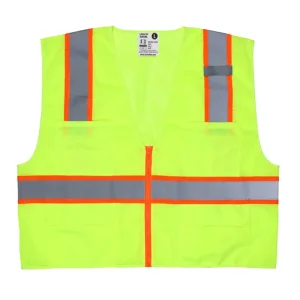
- Type R, Class 2: Requires a minimum of $775 \text{ in}^2$ ($0.50 \text{ m}^2$) of fluorescent background fabric and $201 \text{ in}^2$ ($0.13 \text{ m}^2$) of retroreflective material (minimum 1.38-inch width). Designed for workers exposed to traffic exceeding 25 mph.
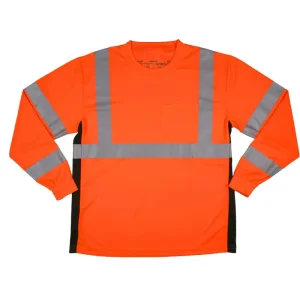
- Type R, Class 3: Requires a minimum of $1,240 \text{ in}^2$ ($0.80 \text{ m}^2$) of fluorescent fabric and $310 \text{ in}^2$ ($0.20 \text{ m}^2$) of retroreflective material (minimum 2-inch width). Class 3 garments must incorporate full sleeve coverage with retroreflective bands around the arms to establish a recognizable human silhouette.
- Type O (Off-Road) & Type P (Public Safety): Specialized classifications for non-roadway occupational hazards and emergency responders.
EN ISO 20471:2013+A1:2016 Standard (Europe & Global)
The European standard enforces rigid photometric specifications across three distinct classes based on surface area measurements:
- Class 1: Lowest visibility level ($0.14 \text{ m}^2$ background material, $0.10 \text{ m}^2$ reflective tape).
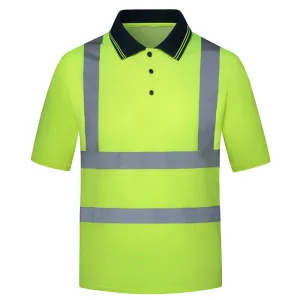
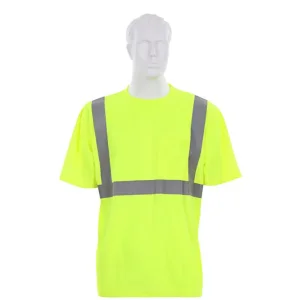
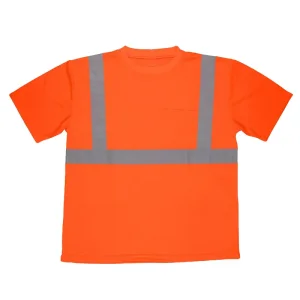
- Class 2: Intermediate level ($0.50 \text{ m}^2$ background material, $0.13 \text{ m}^2$ reflective tape), common for short-sleeve safety shirts and polo shirts.
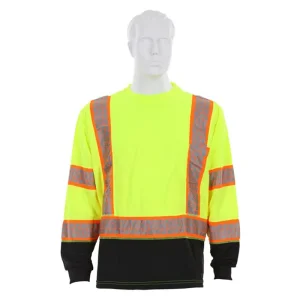
- Class 3: Highest level ($0.80 \text{ m}^2$ background material, $0.20 \text{ m}^2$ reflective tape), achieved by long-sleeve safety shirts with torso and arm reflective striping.
4. Macro Industry Solutions & Sector-Specific Workwear Blueprints
Different industrial sectors present unique environmental hazards, physical stresses, and ergonomic challenges. Tailoring hi-vis safety shirts to specific operational environments increases worker compliance and efficiency.
Construction & Infrastructure
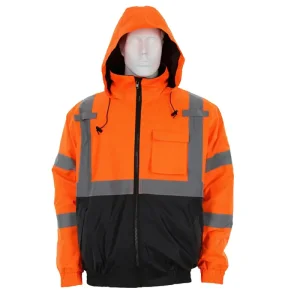
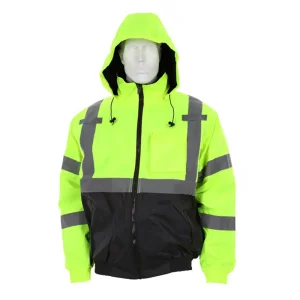
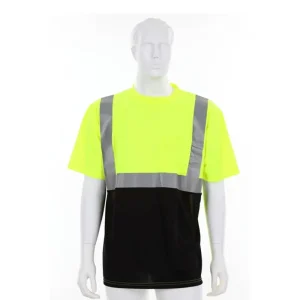
High-abrasion environments require reinforced double-needle stitching, dirt-concealing black bottom panels, and breathable birdseye polyester to withstand rugged site conditions while maintaining ANSI Class 2 or Class 3 compliance.
Logistics & Warehousing
Indoor/outdoor transit zones require high-mobility segmented reflective heat-transfer strips that allow stretch and flex during heavy lifting, combined with anti-pilling, moisture-wicking interlock fabrics.
Oil, Gas & Petrochemical
Explosive or chemical environments demand inherent flame-resistant (FR) fabrics, anti-static carbon yarns, non-conductive plastic press studs or covered zippers, preventing sparks and electric arc risks.
5. OEM/ODM Supply Chain Architecture & Factory Auditing
Partnering directly with an established China-based safety clothing factory like Yongkang Wow Safety Products Co., Ltd. unlocks massive cost efficiencies, flexible customization capabilities, and reliable supply chain governance. However, global buyers must establish rigorous quality assurance protocols during factory selection.
Key Audit & Quality Assurance Criteria
- Social Responsibility & Ethical Compliance: Ensure factories hold valid BSCI (Business Social Compliance Initiative) or SMETA (SEDEX) audit certificates, guaranteeing ethical working conditions and zero child labor.
- ISO 9001 Quality Management Systems: Raw material inspection (AQL 1.5 standards), spectrophotometer color matching (Delta E < 1.0), seam strength testing, and systematic inline quality checkpoints.
- Custom Branding & OEM Capabilities: Screen printing, silk transfer, embroidery, and private labeling options tailored to maintain compliance without blocking the minimal required area of fluorescent background fabric.
6. Technological Roadmap & Future Outlook (2025–2030)
The next decade will witness a convergence of smart textile electronics, sustainable material circularity, and advanced active illumination in high-visibility workwear manufacturing.
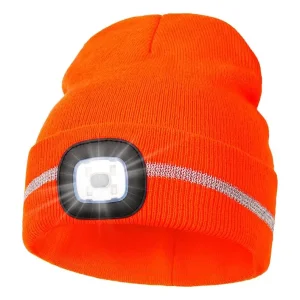
- Integrated Active LED & Photoluminescent Yarns: Moving beyond passive light reflection, future safety shirts feature washable micro-LED light guides and photoluminescent glow-in-the-dark threads providing visibility in total ambient darkness.
- Recycled Polyester (rPET) Circularity: Utilizing post-consumer recycled plastic bottles converted into GRS-certified (Global Recycled Standard) polyester yarns, reducing carbon footprints by up to 45% without sacrificing color brilliance or tensile strength.
- Wearable Biometric & IoT Sensors: Embedded stretchable sensor circuits tracking worker core temperature, heart rate, fatigue levels, and hazardous gas exposure in real-time.
7. Enterprise Localization & Global Compliance Guarantees
For international buyers in North America, Europe, Australia, and the Middle East, seamless logistics, custom clearance documentation, and localized standard compliance are essential. Enterprise suppliers offer complete Incoterms coverage—including FOB Ningbo/Shanghai, CIF, DDP (Delivered Duty Paid)—alongside complete Technical Construction Files (TCF) required for CE and UKCA regulatory declarations.