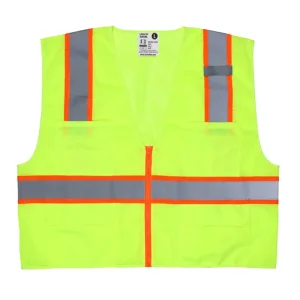
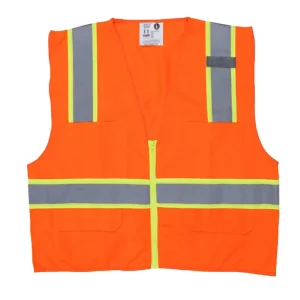
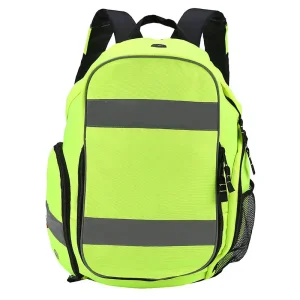
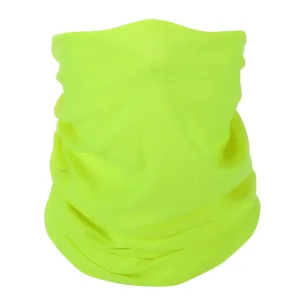
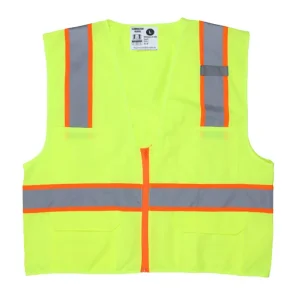
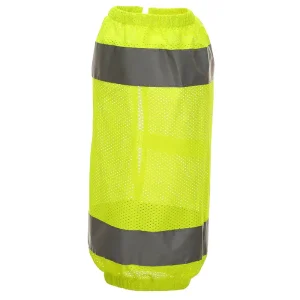
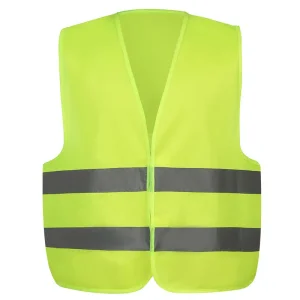
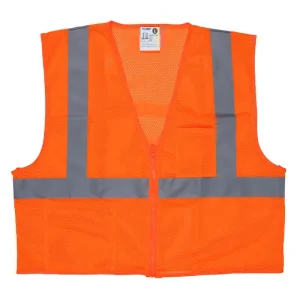
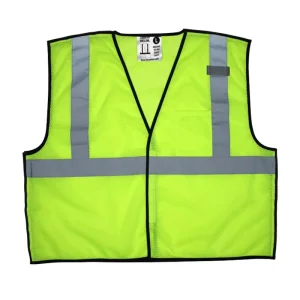
Explore our top-tier certified high-visibility safety apparel manufactured for global extreme weather and heavy industrial applications.
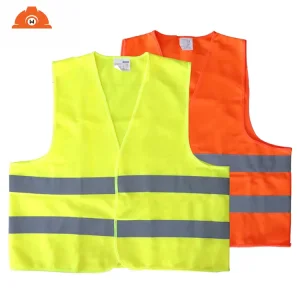
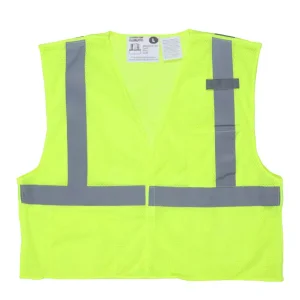
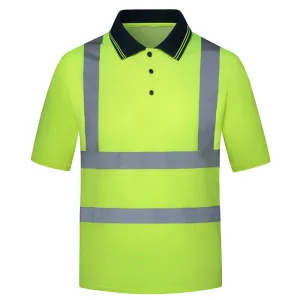
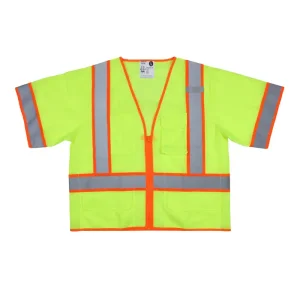
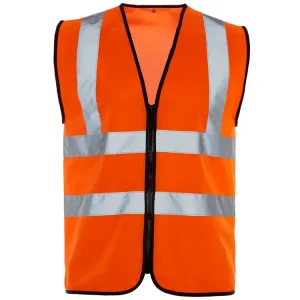
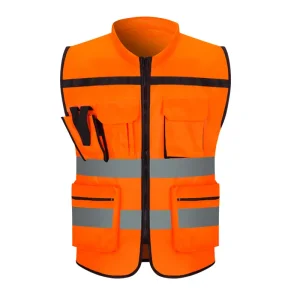
Navigating the intersection of photometric retroreflection and thermodynamic insulation in low-temperature industrial environments.
Standard safety vests fail in extreme cold due to fabric stiffening and lack of thermal entrapment. Winter safety vests engineer synthetic thermal barriers (160–220 gsm polyester silk-cotton or quilted fleece) that maintain a microclimate Clo insulation rating of 0.45 to 0.85 m²K/W, suppressing hypothermia risks without restricting core body range of motion.
Sub-zero conditions cause inferior reflective tapes to crack and lose retroreflectivity. Premium micro-prismatic and high-index glass bead tapes ($R_A > 330 \text{ cd}/(\text{lx}\cdot\text{m}^2)$) are laminated using specialized polyurethane adhesives that remain flexible down to -30°C, ensuring compliance with EN ISO 20471 Class 2/3 photometric minimums.
Winter operations introduce sleet, snow, and freezing drizzle. Outer shells constructed from 300D to 600D Polyester Oxford with microporous PU backing deliver hydrostatic head resistance exceed 5,000 mm H2O, coupled with water-repellent (DWR) surface treatments that prevent fabric saturation and thermal bridging.
Procurement audits demonstrate that specifying multi-norm winter safety vests (combining EN ISO 20471 high visibility with EN 14058 thermal protection and EN 343 water permeability) reduces seasonal worker turnover by 18% and decreases workplace cold-stress incidents by up to 42% in Arctic logistics hubs.
A comparative evaluation of international safety mandates regulating high-visibility thermal apparel across global jurisdictions.
| Standard Specification | Regional Scope | Key Performance Requirements | Minimum Background Fabric Area | Reflective Material Threshold | Thermal & Moisture Criteria |
|---|---|---|---|---|---|
| ANSI/ISEA 107-2020 (Type R Class 2) | North America / USA | Roadway and traffic control compliance for workers exposed to traffic >25 mph. | 0.50 m² (775 in²) | 0.13 m² (201 in²) retroreflective tape | Optional thermal lining; must maintain dimensional stability after wash. |
| ANSI/ISEA 107-2020 (Type R Class 3) | North America / USA | High-risk environments, sub-zero highway work, high-speed zones (>50 mph). | 0.80 m² (1240 in²) | 0.20 m² (310 in²) retroreflective tape | Full torso and sleeve coverage required; high wind-blocking rating. |
| EN ISO 20471:2013 + A1:2016 | European Union / Global | Three-class system based on risk zone velocity and visual contrast. | Class 2: 0.50 m² Class 3: 0.80 m² |
Class 2: 0.13 m² Class 3: 0.20 m² |
Colorfastness to cold weathering, xenostest UV exposure (>Level 4). |
| EN 342:2017 Protective Clothing | European Union | Ensembles and garments for protection against extreme cold (< -5°C). | Full Body Coverage Integration | Integrates with EN ISO 20471 tapes | Thermal insulation ($I_{cler} > 0.310 \text{ m}^2\text{K/W}$); air permeability Class 1-3. |
| EN 14058:2017 Garments for Cool | European Union | Protection in cool environments (-5°C and above). | Torso protection focus | Photometric tape integration | Thermal resistance $R_{ct}$ Class 1-4; optional water penetration resistance. |
| CSA Z96-15 (High Visibility Safety) | Canada | Canadian safety mandate for winter infrastructure and mining operations. | Class 2: 0.50 m² Class 3: 0.80 m² |
Symmetrical X-back pattern required on reverse torso | Cold-flex tape testing mandatory at -30°C without cracking. |
Analyzing high-demand B2B sectors requiring bulk safety winter vest supply across key economic regions.
Modern automated warehousing and cold-chain logistics hubs operating down to -25°C demand lightweight, high-mobility winter vests. Multi-pocket designs equipped with dielectric zippers prevent thermal transfer and electrical spark hazards during forklift battery management.
Ground crews working night shifts in freezing precipitation require Class 3 high-visibility garments with wind-proof 300D Oxford shells, dual mic tabs for radio comms, and flame-retardant (FR) anti-static treatments meeting ISO 11612 specifications.
Northern European and North American coastal roadwork and offshore oil platforms require water-repellent, high-visibility insulated vests certified to withstand salt-spray corrosion, chemical splash, and heavy mechanical abrasion.
Inside Yongkang Wow Safety Products Co., Ltd. — Tailored contract manufacturing for global distributors and safety brands.
Operating out of our 6,000 m² facility in Jinhua City, Zhejiang, Yongkang Wow Safety Products Co., Ltd. utilizes computer-guided automatic fabric nesting cutters, seamless hot-air tape sealing machines, and automated pattern stitching. This setup guarantees dimensional precision ($\pm 0.5 \text{ cm}$ variance) across high-volume production batches, producing over 300,000 safety vests monthly.
We provide full customization protocols: custom pantone dyeing for fluorescent lime-yellow and orange-red background fabrics, screen printing, heat transfer logo application within non-certified zones, custom zipper pulls, and private-label compliance tagging compliant with EU Regulation 2016/425 (PPE Category II).
Pioneering the next generation of smart, sustainable, and active-illuminating winter safety vests.
Integration of flexible ultra-thin carbon fiber heating pads powered by low-voltage 5V/7.4V USB power banks. Embedded micro-thermostats provide 3-zone targeted core warming (chest and lower back), extending worker operational endurance in Arctic environments down to -40°C.
Combining passive retroreflectivity with active micro-LED striping and photoluminescent glow technology. This dual-system ensures visibility even when no external light source (such as vehicle headlights) strikes the garment, crucial for unlit railway yards and dark mining shafts.
Transitioning to 100% GRS-certified Recycled PET (rPET) derived from post-consumer plastic bottles. Combined with fluorine-free DWR (PFAS-free water repellency) and biodegradable thermal insulation, meeting global corporate ESG procurement mandates.
Direct technical answers addressing critical wholesale, compliance, and custom OEM manufacturing inquiries.
Our standard MOQ for custom OEM/ODM safety winter vests starts at 500 units per colorway for standard fluorescent lime-yellow or orange fabrics. For fully customized pantone fabric dyeing or specialized technical linings (e.g., flame-retardant or anti-static fleece), the baseline MOQ is 1,000 units per specification. Sample development typically takes 5–7 business days upon receipt of artwork files.
Every batch of raw background fabric and retroreflective tape undergoes rigorous third-party testing (SATRA, TÜV, or SGS certified) to verify chromaticity coordinates, total luminance factor, and retroreflectivity ($R_A > 330 \text{ cd}/(\text{lx}\cdot\text{m}^2)$). Our in-house QC laboratory conducts pre-shipment wash durability tests (certified up to 50 industrial wash cycles at 60°C) and cold-flex cracking inspections down to -20°C.
Yes. Both EN ISO 20471 and ANSI/ISEA 107 permit logo application provided the total area of the high-visibility background fabric does not drop below the minimum required class threshold (e.g., 0.50 m² for Class 2, 0.80 m² for Class 3). Our CAD technical team conducts precise digital area calculations prior to screen printing or heat-transfer placement to guarantee full legal compliance for public tenders.
EN 14058 governs garments intended for protection in cool environments (temperatures down to -5°C), focusing on thermal resistance ($R_{ct}$) and air permeability. EN 342 regulates complete ensembles or specialized heavy garments engineered for extreme freezing conditions (below -5°C down to Arctic cold), measuring effective thermal insulation ($I_{cler}$) and air tightness under wind-driven sub-zero scenarios.
We recommend 300D or 600D Polyester Oxford weave with PU (Polyurethane) backing. The 600D Oxford offers superior tear resistance ($>120\text{ N}$) and tensile strength against sharp rebar and equipment abrasion, while the microporous PU coating provides waterproofness ($>5,000\text{ mm H}_2\text{O}$) while allowing sweat vapor to escape ($RET < 15\text{ m}^2\text{Pa/W}$).
Standard production lead time for a 20ft/40ft High Cube container (approx. 10,000–25,000 pcs depending on garment bulk and padding thickness) is 30 to 45 calendar days following pre-production sample approval and deposit receipt. Expedited manufacturing channels are available for urgent seasonal municipal procurement contracts.
Explore additional safety garments, rainwear, accessories, and high-visibility solutions from our direct factory catalog.