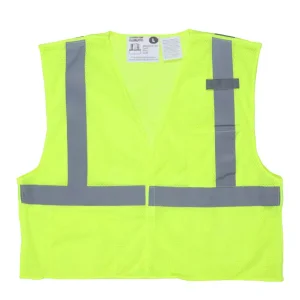
Navigating industrial safety challenges in sub-zero environments: How top China safety vest factories integrate thermal insulation, ergonomic mobility, and certified retroreflection.
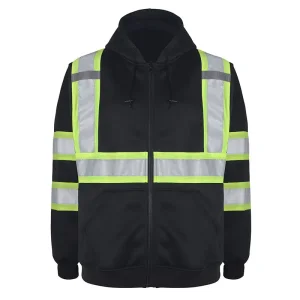
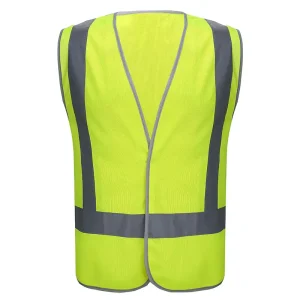
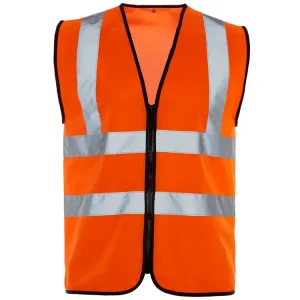
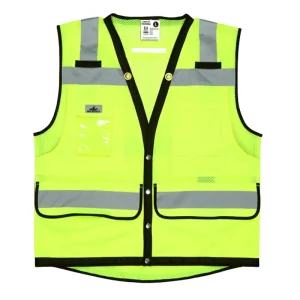
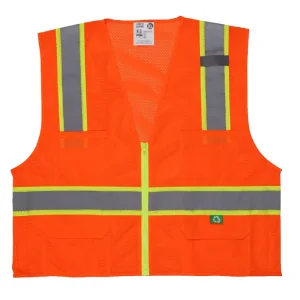
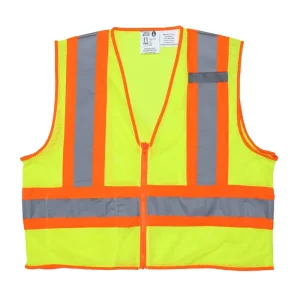
In cold-climate industrial operations—spanning arctic infrastructure projects, sub-zero logistics hubs, highway snow-clearing operations, and winter offshore rigs—Personal Protective Equipment (PPE) faces a severe dual challenge. Workers must maintain 360-degree optical visibility under low-daylight and stormy conditions while being shielded from life-threatening hypothermia and freezing wind-chills. A standard summer mesh vest worn over bulky winter coats fails safety protocols due to standard migration, tear risk, restricted movement, and obscured retroreflective surfaces. As a direct result, enterprise procurement directors, industrial safety managers, and government buyers are turning to specialized China safety vest for winter factory & factories to source purpose-engineered thermal high-visibility garments.
This technical whitepaper provides an exhaustive analysis of the manufacturing processes, material engineering, international safety compliance frameworks (ANSI/ISEA 107-2020, EN ISO 20471:2013+A1, EN 342, EN 343), and supply chain economics governing high-visibility winter workwear produced in China’s industrial manufacturing hubs.
Macro-economic drivers and regulatory mandates shaping the global market for insulated reflective safety apparel.
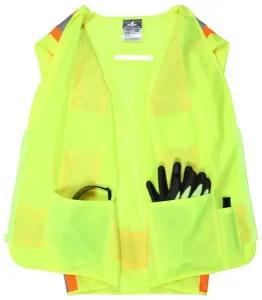
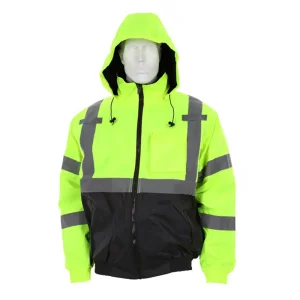
OSHA and DOT enforce strict ANSI Class 3 compliance for highway work zones during winter months. Demand is surging for 3-in-1 multi-norm parkas and heavy-duty fleece-lined safety vests featuring 4-inch contrast striping.
Strict adherence to EN ISO 20471 Class 3 combined with EN 342 (cold environment protection) drives procurement across Scandinavia and Central Europe, requiring non-cracking microprismatic tapes down to -30°C.
The boom in automated cold-storage distribution centers requires specialized thermal hi-vis vests optimized for constant zero-degree transitions, condensation resistance, and ergonomic mobility in restricted aisles.
Deconstructing the multi-layer fabric technology engineered by advanced OEM China factories.
Winter safety vests require high-denier outer fabrics capable of resisting tearing from sharp equipment and abrasive ice. China factories utilize 300D to 600D Oxford Weave Polyester treated with a Polyurethane (PU) or Thermoplastic Polyurethane (TPU) microporous backing. This construction delivers a hydrostatic head exceeding 10,000 mm $H_2O$ while providing breathability ratings above 5,000 $g/m^2/24h$, preventing sweat condensation from freezing inside the garment.
Retaining core body warmth requires hydrophobic insulation materials that maintain loft even in high-humidity ambient environments. Preferred thermal layers include:
In winter conditions, glass-bead reflective tapes can suffer micro-fractures or loss of retroreflectivity due to frost build-up. Top manufacturers deploy microprismatic retroreflective tapes engineered with cold-flex additives. These tapes maintain high retroreflection values ($R_A > 330 \text{ cd/lux/m}^2$) down to -35°C and survive up to 50 industrial washing cycles under ISO 6330 standards.
| Performance Parameter | Standard Winter Mesh Vest | Industrial Insulated Winter Safety Vest | Testing Method / Standard |
|---|---|---|---|
| Outer Shell Durability | 120D Polyester Tricot | 300D / 600D Heavy-Duty Oxford (PU Coated) | ISO 13934-1 (Tear Strength) |
| Waterproof Rating | Non-Waterproof (<500 mm) | 5,000 mm – 10,000 mm $H_2O$ (Seam Sealed) | EN 343 Class 3/4 |
| Thermal Resistance ($R_{ct}$) | Negligible | 0.25 – 0.38 $m^2 \cdot K/W$ | EN 342 / ISO 11092 |
| Retroreflectivity Grade | Standard Glass Bead (Class 2) | Cold-Flex Microprismatic / High-Gloss Glass Bead | ANSI/ISEA 107 / EN ISO 20471 |
| Sub-Zero Flexibility | Becomes Brittle at -5°C | Flexible down to -35°C without Cracking | ASTM D2136 Cold Bend Test |
How tailored winter safety vest configurations meet unique environmental operational demands.
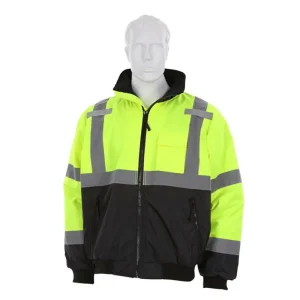
Highway crews operating snowplows require Class 3 high-visibility jackets featuring 4-inch contrast striping, heavy-duty storm flaps, tear-away breakaway zippers for machinery safety, and radio mic tabs.
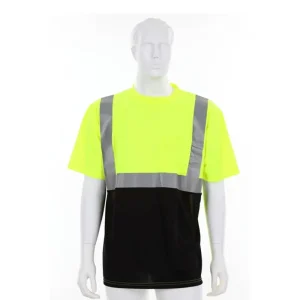
Ground handling crews facing severe tarmac winds require windproof softshell winter safety vests equipped with non-conductive dielectric zippers, dual tablet pockets, and high-visibility lime-yellow backgrounds.
Warehouse personnel shifting between freezer vaults (-25°C) and ambient dock bays require lightweight insulated fleece vests with flexible side stretch panels to maintain agility without overheating.
Next-generation innovations emerging from China’s leading safety clothing R&D centers.
Integration of ultra-thin, washable graphene heating elements powered by low-voltage 5V power banks, allowing workers to manually control thermal zones based on activity levels.
100% closed-loop recyclable winter PPE using recycled ocean plastics (rPET), bio-based PU coatings, and PFC-free durable water-repellent (DWR) surface treatments.
Smart safety vests equipped with integrated ambient temperature sensors, heart-rate monitors, passive RFID asset tracking, and electroluminescent LED strips for active illumination.
Essential evaluation guidelines for global procurement officers selecting China OEM/ODM partners.
Selecting the right China safety vest for winter factory & factories requires looking beyond unit pricing. B2B buyers must evaluate factory infrastructure against stringent operational criteria:
Verify that the factory utilizes hot-air seam sealing equipment to tape every stitched seam on waterproof winter coats, preventing water penetration under rain and melting snow.
Leading factories maintain internal optical darkrooms equipped with retroreflectometers to test tape reflectivity before, during, and after wash cycle testing.
Ensure your supplier holds valid BSCI, SMETA (SEDEX), or ISO 9001 certifications, guaranteeing compliant labor practices and consistent quality management systems.
Expert technical responses to common engineering and sourcing queries.