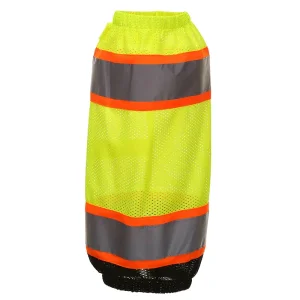
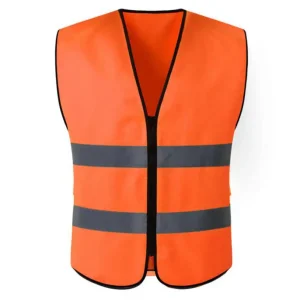
- Yongkang, Jinhua City, Zhejiang, China
- [email protected]
- +86-0579-87121726


Precision-engineered high-visibility safety clothing manufactured directly from our Yongkang production facilities, adhering strictly to global ISO and ANSI safety ratings.
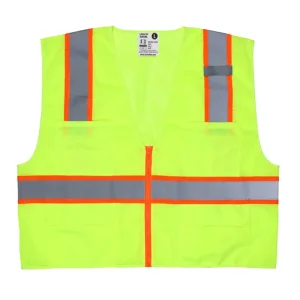
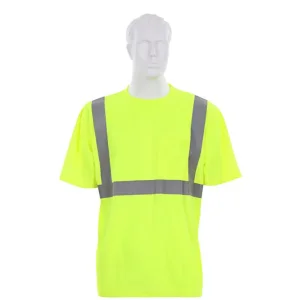
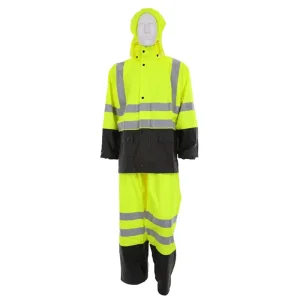
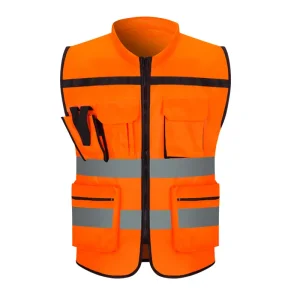
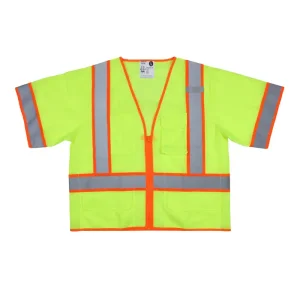
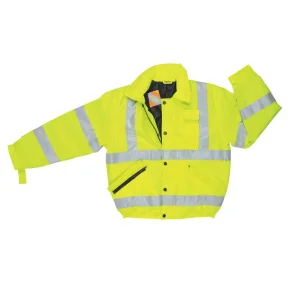
In the realm of international Personal Protective Equipment (PPE) manufacturing, the high-visibility insulated jacket represents the pinnacle of complex technical apparel. Unlike standard 120 gsm single-layer polyester mesh vests, an insulated high-visibility jacket must concurrently solve three major engineering bottlenecks: photometric visibility compliance (EN ISO 20471 / ANSI 107), extreme thermal insulation performance (EN 342), and waterproof/breathable weatherproofing (EN 343).
When global buyers evaluate procurement channels for China High Visibility Insulated Jacket Manufacturers & Factory partnerships, understanding geographic industrial clusters is vital for optimizing supply chain efficiency. Located in Zhejiang Province, Yongkang serves as a centralized hub for safety product manufacturing, offering immediate access to raw fabric weavers, retroreflective film coaters, zipper foundries, and specialized technical sewing workforces.
Our factory controls the entire manufacturing chain—from raw polyester yarn spinning, yarn-dyeing for high-luminance fluorescent dyes (yellow-green, orange-red), down to automated laser-cutting, hot-melt tape sealing, and final photometric laboratory testing.
Maintaining extensive strategic reserves of 300D and 600D Oxford fabrics, PU coatings, micro-prismatic tape, and 120-220 gsm thermal polyfill allows us to mitigate market volatility and deliver aggressive volume pricing for major corporate tenders.
Operating under ISO 9001 quality systems, every single production lot undergoes rigorous inspection for seam tension, hydrostatic head resistance, retroreflective coefficient retention after cold flex testing, and chromaticity coordinates.
An insulated hi-vis jacket engineered for cold environments (-20°C to -40°C) must maintain heat equilibrium without inducing worker transpiration moisture accumulation. Accumulated perspiration drastically reduces garment insulation values once activity slows. Therefore, material selection is engineered as a multi-tier system:
We utilize heavy-duty 300D to 600D Polyester Oxford woven shell fabrics laminated with a microporous TPU (Thermoplastic Polyurethane) membrane. This yields a hydrophobic surface capable of withstanding hydrostatic pressures exceeding 10,000 mm H₂O while maintaining water vapor permeability (breathability) of > 5,000 g/m²/24h.
Depending on regional climate specs, our core insulation uses 120 gsm to 250 gsm high-loft polyester microfibers or recycled thermal insulation (GRS Certified). The hollow fibers trap microscopic air pockets, establishing an thermal barrier ($I_{cler}$ up to $0.380 \text{ m}^2\cdot\text{K/W}$) that retains core warmth without restricting mobility.
Stitching needles create thousands of microscopic punctures through fabric and TPU membranes. Our factory deploys high-temperature hot-air seam sealing equipment to apply 22mm-wide polyurethane sealing tapes over all structural seams, guaranteeing 100% waterproof integrity under extreme rain and thawing snow conditions.
For safety equipment importers, structural non-compliance can result in severe legal liabilities, customs rejections, or recalled inventory. Direct collaboration with a specialized manufacturer guarantees that fluorescent background materials and retroreflective bands strictly align with target market requirements.
| Standard / Regulation | Geographic Region | Core Focus Area | Technical Thresholds Required |
|---|---|---|---|
| EN ISO 20471:2013+A1:2016 | European Union / UK (UKCA) | High visibility apparel for high-risk zones | Class 3 requires ≥0.80 m² fluorescent background material and ≥0.20 m² retroreflective tape. |
| ANSI/ISEA 107-2020 | North America (USA) | High-visibility safety apparel & headwear | Type R Class 3 requires 1,240 sq. in. background material & 310 sq. in. retroreflective tape. |
| EN 342:2017 | European Union / International | Ensembles & garments for protection against cold | Measures thermal insulation ($I_{cler}$), air permeability (Class 1-3), and water penetration resistance. |
| EN 343:2019 | European Union / International | Protection against rain and extreme wet weather | Rates Water Penetration Resistance (Class 1-4) & Water Vapor Resistance / Breathability (Class 1-4). |
| CSA Z96-15 | Canada | High-visibility safety apparel for Canadian worksites | Specifies full body harness coverage layout with retroreflective 'X' pattern on the back panel. |
A single design cannot meet the diverse operational challenges encountered across different global work environments. As an experienced OEM/ODM factory, we tailor garment construction, pocket ergonomics, and material packages to match targeted industrial end-use scenarios:
Workers exposed to high-speed traffic during night shifts demand maximum visual contrast. We engineer 3-in-1 modular insulated jackets featuring 3M™ Scotchlite™ micro-prismatic segmented tape for enhanced nighttime visibility, combined with 300D Oxford outer shells treated for dirt and grease resistance.
Freezer warehouse personnel operate continuously in ambient temperatures ranging from -18°C to -30°C. For this application, garments prioritize inner thermal retention and flexible knit cuffs, featuring fleece-lined storm collars, heavy-duty two-way front zippers, and reinforced elbow patch panels.
Demanding marine and arctic environments require multi-hazard protection. We integrate flame-retardant (FR) treated background fabrics, anti-static carbon filaments, and arc-flash protective lining options alongside high-visibility yellow or orange retroreflective configurations.
Partnering with a specialized Chinese factory streamlines high-volume PPE production. Our engineering team guides international buyers through a transparent, stage-gated manufacturing protocol designed to eliminate production errors and protect brand reputation:
Buyers supply tech packs or physical reference samples. Our pattern engineers evaluate total surface area in square meters for fluorescent background and retroreflective tape across all size runs (S to 5XL) to ensure compliance before cutting fabric.
Within 7 to 10 days, we deliver fully customized counter-samples incorporating client branding, custom zipper pulls, woven neck labels, hang tags, and exact color-matched fabrics for formal client sign-off.
Upon sample sign-off, bulk fabric undergoes automated spreading and precision laser cutting. Sewing assembly lines execute bar-tacking on stress points, double-needle seam reinforcing, and hot-melt seam tape application.
Final shipments are sampled according to ISO 2859-1 (AQL 2.5/4.0) standards. We verify garment dimensions, zipper durability, water pressure resistance, and tape adhesion, providing complete photo reports prior to container dispatch.
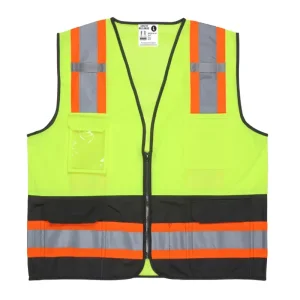
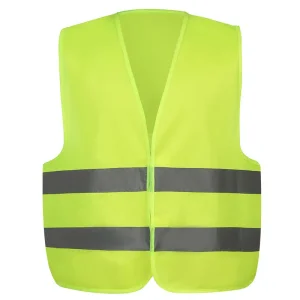
Explore our complete catalog of high-visibility outerwear, reflective safety vests, rainwear, and protective accessories manufactured for global bulk distribution.
In-depth technical answers addressing common engineering, compliance, and logistics questions from professional PPE buyers, importers, and brand managers.
For standard production using inventory raw materials (such as stock 300D Oxford fluorescent yellow or orange fabric with glass-bead tape), our minimum order quantity is 300 to 500 pieces per style/color. For bespoke PMS fluorescent dye shades, custom-knitted cuffs, or specialized micro-prismatic tape patterns, the baseline MOQ is 1,000 pieces per run. Mixed size curves (S through 5XL) inside a single style are fully supported.
Screen printing or heat-transfer embroidery over fluorescent background fabric reduces the measured surface area of compliant fluorescent material. Our pattern development team performs digital surface mapping on your artwork to ensure logo sizing and placement (whether chest, back, or sleeve) do not drop the garment below Class 2 or Class 3 minimum area thresholds. We also offer flame-retardant print inks for specialized workwear.
Standard PVC coatings often crack or stiffen when exposed to sub-zero temperatures (-15°C and below). Our high-visibility winter jackets utilize polyether-based TPU coatings and low-temperature flexible retroreflective films engineered to maintain flex-crack resistance down to -40°C. Test reports from accredited laboratories (SATRA, SGS, TUV) are provided during pre-production verification.
Standard domestic hi-vis garments are rated for 25 home wash cycles at 40°C. For industrial rental and utility fleet programs, we manufacture utilizing industrial-grade reflective tapes and heavy-duty 100% polyester background shell fabrics capable of passing 50+ industrial laundry cycles at 60°C (ISO 15797 compliance), preserving both retroreflective coefficients ($R_A > 330 \text{ cd/(lx}\cdot\text{m}^2)$) and background chromaticity.
Technical sample development takes 7 to 10 working days following spec approval. Bulk manufacturing timelines average 25 to 35 calendar days for standard vests and shirts, and 35 to 45 calendar days for multi-layer seam-sealed insulated jackets, heavy winter parkas, and complex rainwear. Fast-track production slots are available for urgent government or utility contract tenders.
Yes. We supply comprehensive OEM packaging solutions—including individualized polybags with warning prints, custom EAN/UPC barcode stickers, color size cubes, display hangtags, and heavy-duty double-wall corrugated export master cartons. We accommodate FCL/LCL ocean freight, air express, and DDP (Delivered Duty Paid) shipping directly to distribution hubs across North America, Europe, Australia, and South America.
Partner directly with Yongkang's leading OEM high-visibility outerwear manufacturer. Request a factory-direct quote, order technical samples, or consult with our protective apparel engineers today.