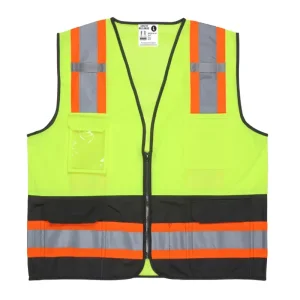
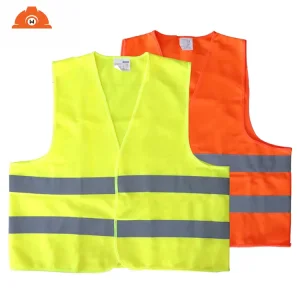
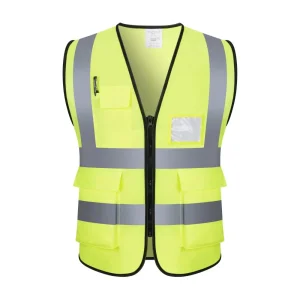
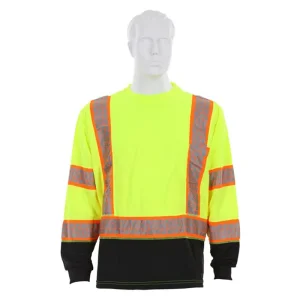
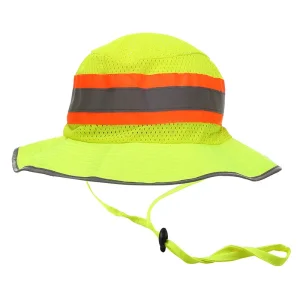
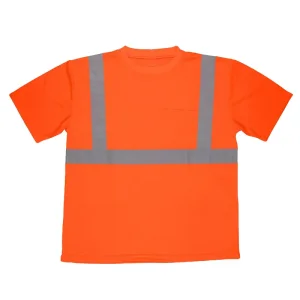
Explore our top-performing wholesale high-visibility vests, shirts, jackets, and safety mesh gear engineered for extreme thermal comfort, high retroreflectivity, and rigorous job-site durability.
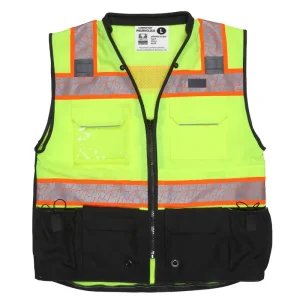
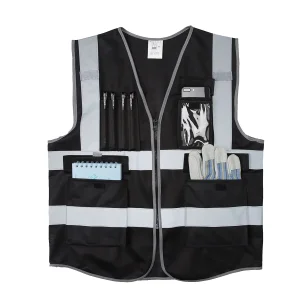
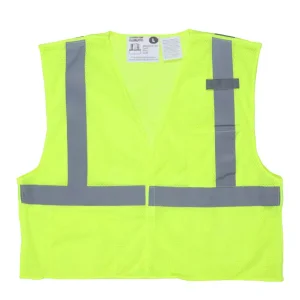
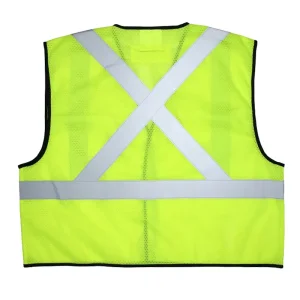
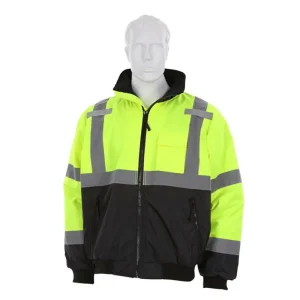
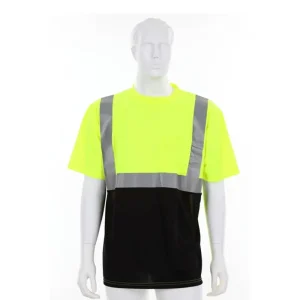
The high-visibility safety clothing market is undergoing a structural paradigm shift driven by stringent occupational health and safety (OHS) regulations, global infrastructure acceleration, and rising ambient temperatures worldwide.
In modern industrial job sites—spanning heavy civil construction, highway maintenance, maritime cargo handling, and airport tarmac operations—worker safety is directly tied to visual conspicuity. Historically, high-visibility garments relied on heavy, solid-woven polyester fabrics. However, as global workplace safety standards (such as OSHA in the United States, EU-OSHA in Europe, and Safe Work Australia) enforce mandatory year-round wearing of Class 2 and Class 3 garments, heat stress has emerged as a primary occupational hazard.
This reality has accelerated the massive global transition toward High-Visibility Polyester Mesh Fabrics. Unlike traditional solid fabrics, mesh constructions provide open-weave ventilation channels that drastically increase air permeability, accelerate evaporative cooling, and reduce thermal strain on workers operating in ambient temperatures exceeding 30°C (86°F).
Global megaprojects—such as North American highway modernization, European rail expansion, and Middle Eastern urban development—have created unprecedented bulk procurement demand for compliant mesh safety vests and shirts.
Safety directors now recognize that heat exhaustion leads to reduced cognitive awareness and higher accident rates. Breathable mesh workwear is specified as an essential Personal Protective Equipment (PPE) component to maintain worker focus.
Enterprise fleets and multinational engineering contractors are consolidating procurement around standardized mesh vest specifications with integrated multi-functional pockets, radio tabs, and non-conductive closures.
High-performance hi-vis mesh requires a precise balance between structural tensile strength, fluorescent dye fastness, air permeability, and retroreflective ribbon bonding.
Not all mesh fabrics are engineered equally. When sourcing Wholesale Hi Viz Mesh Suppliers, B2B buyers must evaluate key textile metrics including Grams per Square Meter (GSM), yarn denier count, weave geometry, and compliance with ISO 9237 air permeability standards.
Attaching rigid retroreflective tape onto highly flexible, open-pore mesh fabric presents technical challenges. Superior manufacturing processes utilize heat-transfer microprismatic tape or glass-bead tape sewn with double-needle lockstitching to prevent delamination during high-frequency industrial laundering (ISO 15797 standards).
| Fabric Type | Weight (GSM) | Air Permeability (ISO 9237) | Tear Strength (ISO 13937) | Primary Industrial Application |
|---|---|---|---|---|
| 100% Warp-Knitted Polyester Mesh | 110 - 130 GSM | > 1,200 mm/s | High Tensile Resilience | Summer Road Work, Traffic Control, Landscaping |
| Polyester Birdseye Moisture-Wicking Mesh | 140 - 160 GSM | > 950 mm/s | Soft Touch & Pilling Resistant | Hi-Vis Short/Long Sleeve Work T-Shirts |
| Hybrid Mesh Top / Solid Bottom | 120 / 150 GSM | 650 mm/s (Combined) | Extra Pocket Support | Surveyor Vests with Heavy Tool Loadouts |
| FR-Treated Modacrylic / Cotton Mesh | 150 - 180 GSM | 800 mm/s | Flame Retardant (NFPA 70E) | Oil & Gas Platforms, Electrical Utilities |
How Chinese manufacturing hubs like Yongkang Wow Safety Products Co., Ltd. deliver unprecedented economies of scale, strict quality assurance, and OEM/ODM customization for international buyers.
Located in Zhejiang province, our facilities benefit from immediate proximity to world-class polyester yarn extruders, dye houses specializing in fluorescent pigments (Fluorescent Yellow-Green and Fluorescent Orange-Red), zipper manufacturers, and retroreflective tape mills. This eliminates logistics friction and reduces lead times by up to 35%.
Utilizing computer-controlled CAD/CAM laser spreading and cutting machines, our factory guarantees millimeter-precise panel alignment. This ensures every piece of mesh fabric aligns perfectly with silver retroreflective strips without compromising the minimum certified surface area required by ANSI or EN ISO standards.
Every batch of raw mesh fabric undergoes spectrophotometer color measurement (CIE L*a*b* coordinates), tensile tear testing, hydrostatic wash testing, and retroreflectivity coefficient evaluation ($R_A \ge 330 \text{ cd}/(\text{lx}\cdot\text{m}^2)$) prior to bulk stitching assembly.
Navigating regulatory demands across North America, Europe, Australia, and Asia-Pacific to ensure total job-site compliance.
Requires specific minimum square inches of background mesh and retroreflective tape. Categorized by Type R (Roadway), Type P (Public Safety), and Type O (Off-Roadway), spanning Class 1, Class 2, and Class 3 configurations. Features such as dielectric zippers and breakaway shoulders are frequently mandated.
Mandates strict colorimetric coordinates ($x, y$) and luminance factors ($\beta$) for background fabric after multiple wash cycles. Enforces Class 1, Class 2, and Class 3 performance levels based on vehicle speeds in the working environment.
Distinguishes between Day Only (Class D), Night Only (Class N), and Day/Night (Class D/N) garments. Incorporates mandatory harness access slits and "X-Pattern" reflective back configurations for railway track workers.
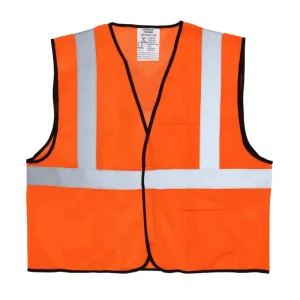
Requires high-durability Class 2 mesh vests with reinforced heavy-duty front zippers, mic tabs, and soil-masking black bottoms to maintain clean appearance during asphalt paving.
Requires 100% metal-free, anti-static micro-mesh vests equipped with transparent ID card holders, dual radio chest pockets, and 360-degree reflectivity for low-light tarmac operations.
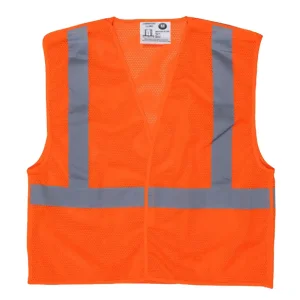
Demands lightweight, ultra-breathable Class 2 mesh vests with quick-release 5-point breakaway Velcro seams to prevent entanglement in high-speed automated conveyor systems.
A strategic roadmap for safety equipment distributors, procurement officers, and brand owners seeking to optimize bulk ordering, private labeling, and supply chain resiliency.
When evaluating potential Wholesale Hi Viz Mesh Suppliers, enterprise buyers must look beyond basic FOB prices. A comprehensive total cost of ownership (TCO) evaluation includes verifying factory compliance certificates (BSCI, ISO 9001, OEKO-TEX Standard 100), inspecting custom OEM printing capabilities, and verifying packaging container loading optimization.
The industry is rapidly adopting GRS-certified (Global Recycled Standard) post-consumer recycled polyester mesh yarn. Forward-thinking buyers are switching to rPET mesh to meet corporate sustainability goals without sacrificing tensile strength or fluorescent brightness.
Next-generation high-visibility mesh garments feature integrated RFID tags for automated laundry management, NFC chips for instant employee certification verification, and active LED illumination strips powered by ultra-light rechargeable batteries.
Optimizing volumetric carton packing allows up to 20,000 pcs of mesh safety vests to fit within a single 40ft HQ container. Proper HS classification (such as HS Code 6114.30 for knitted synthetic apparel) prevents unnecessary customs delays and tariff penalties.
Detailed technical answers to common procurement, compliance, and material engineering questions.
Mesh fabric features an open-weave knit structure that provides high air permeability (ISO 9237 > 1000 mm/s), drastically improving breathability and thermal heat dissipation. In warm ambient climates or high-intensity physical work environments, mesh vests reduce heat stress and sweat accumulation while fully maintaining certified ANSI/ISEA 107 and EN ISO 20471 fluorescent background surface area requirements.
Standard high-visibility mesh vests certified under ANSI/ISEA 107 or EN ISO 20471 are typically tested and certified for 25 to 50 domestic wash cycles at 40°C (104°F). Premium quality mesh garments manufactured with heavy-duty bound edges and premium microprismatic retroreflective tapes retain minimum retroreflective values ($R_A \ge 100 \text{ cd}/(\text{lx}\cdot\text{m}^2)$) and chromaticity limits up to 50 industrial laundering cycles.
Yes, provided the printed logo does not obscure the minimum required square inches of certified fluorescent background mesh or retroreflective tape. Custom logos are typically silk-screened or heat-transferred onto solid chest panels, back panels above/below reflective stripes, or pocket flaps. Our engineering team provides pre-production digital mockups calculating visible surface area to guarantee 100% compliance.
Dielectric zippers are non-conductive zippers made entirely of molded resin or heavy-duty plastic with zero metallic components. They are mandated for electrical utility workers, linemen, and electricians working near high-voltage power lines or arc-flash hazards to eliminate electric arc bridging risks.
Standard Minimum Order Quantities (MOQ) start at 500 to 1,000 units per style for standard colors (Fluorescent Lime-Yellow / Fluorescent Orange-Red). Sample development takes 3 to 5 business days, while mass production turnarounds range between 20 and 30 days depending on custom feature complexity, custom dyeing specs, and order volume.
ANSI Class 2 garments require a minimum of 775 sq. inches of background material and 201 sq. inches of retroreflective tape, making them suitable for traffic moving above 25 mph. Class 3 garments require a minimum of 1,240 sq. inches of background material and 310 sq. inches of retroreflective tape—mandating sleeves with reflective bands around arms and torso—designed for workers exposed to high-speed traffic (>50 mph) or high-risk emergency work.
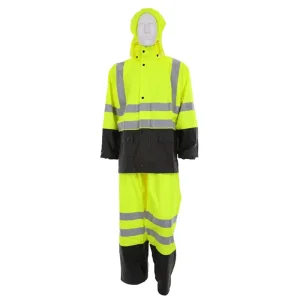
Discover our comprehensive selection of reflective rainwear, work jackets, birdseye safety t-shirts, headwear, and specialized accessories for global B2B procurement.