Direct factory supply engineered with premium retroreflective tapes, compliant fluorescent base fabrics, and ergonomic structural designs.
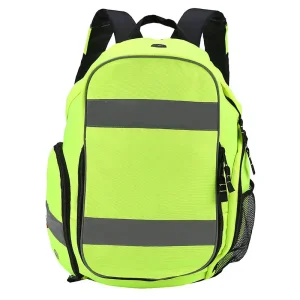
Analyzing regulatory shifts, industrial safety mandates, and supply chain demands across global high-visibility workwear sectors.
Strict occupational safety enforcement by OSHA (USA), EU PPE Regulation (EU 2016/425), and Safe Work Australia has shifted high-visibility outerwear from optional safety gear to legally mandated Personal Protective Equipment (PPE). Employers face substantial liability risks, making certified garments non-negotiable.
Modern procurement managers demand multi-norm outer shells. Today's industrial Hi-Vis outerwear must combine daytime fluorescent contrast, nighttime micro-prismatic retroreflection, windproofing, hydrostatic waterproof insulation (EN 343 standard), and arc-flash flame resistance into a single ergonomic garment.
Global buyers are moving away from low-durability disposable workwear toward high-cycle industrial laundering garments. Outerwear specified for 50+ ISO 6330 wash cycles reduces per-wear costs by over 40% annually, optimizing corporate procurement budgets.
Direct comparative breakdown of international safety requirements for high-visibility outerwear manufacturing and engineering.
| Technical Parameter | ANSI/ISEA 107-2020 Standard (US/Global) | EN ISO 20471:2013 Standard (EU/UK) | Yongkang Wow Safety Manufacturing Benchmark |
|---|---|---|---|
| Class 3 Outerwear Base Fabric | Minimum 0.80 m² (1240 sq. in.) fluorescent material | Minimum 0.80 m² fluorescent background fabric | 0.85 – 0.92 m² premium high-density Oxford/Knit |
| Retroreflective Tape Area | Minimum 0.20 m² (310 sq. in.) reflective trim | Minimum 0.20 m² Class 2 retroreflective trim | 0.22 – 0.25 m² 3M Glass-Bead / Micro-prismatic |
| Photometric Performance ($R_A$) | $\ge 330 \text{ cd}/(\text{lx}\cdot\text{m}^2)$ coefficient of retroreflection | $\ge 330 \text{ cd}/(\text{lx}\cdot\text{m}^2)$ Level 2 reflective performance | $\ge 400 – 450 \text{ cd}/(\text{lx}\cdot\text{m}^2)$ Ultra-Bright |
| Waterproof / Breathability | ASTM F1670 / F1671 Fluid & Blood Penetration | EN 343 Waterproof Class 3 / Breathability Class 3 | Hydrostatic Head > 10,000mm H₂O | WVP > 8,000 g/m²/24h |
| Color Fastness & Washing | AATCC 61 / AATCC 135 25-50 Wash Cycles | ISO 6330 / ISO 15797 25-50 Industrial Launders | ISO 6330 Grade 4+ Color Retention after 50 Cycles |
Leveraging regional industrial clusters, automated garment manufacturing, and integrated material sourcing for maximum unit cost efficiency.
Situated in Zhejiang's premier textile and hardware manufacturing corridor, our factory accesses raw fluorescent dyeing mills, reflective micro-glass bead coaters, zipper factories, and TPU lamination specialists within a 30-mile radius. This eliminates international supply chain friction and drastically lowers lead times.
Our 6,000 m² facility features computer-controlled CAD laser cutting beds that achieve millimeter-accurate pattern alignment, reducing fabric waste by 14%. Waterproof outerwear features automatic hot-air seam sealing machines ensuring 100% leak-proof tape adhesion along all structural stitches.
Every batch of incoming fluorescent polyester, fleece, and 300D Oxford fabric undergoes rigorous lab inspection for chromaticity coordinates, tensile strength, and hydrophobic rating before entering production. Final garments are subjected to 100% visual and dimensional QA checks.
Tailoring high-visibility outerwear specifications to demanding real-world operational environments.
ANSI Class 3 / EN ISO 20471 Class 3: High-speed traffic zones (>50 mph) demand full body coverage. Outerwear utilizes continuous 360° horizontal and vertical band patterns with fluorescent yellow/lime bases for maximum contrast against roadway backdrops.
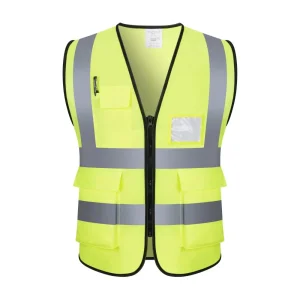
Abrasion-Resistant Reinforced Shells: Incorporating 600D Cordura® elbow patches, dirt-masking black contrast bottoms, radio mic loops, and multi-functional chest utility pockets engineered for survey tools, mobile devices, and ID badges.
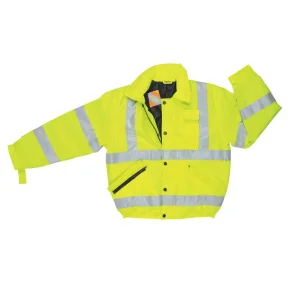
Thermal Insulated Hi-Vis Outerwear: Multi-layer insulated bomber jackets and parkas featuring 200g/m² Thinsulate™ or heavy polyester fleece linings, storm flaps, waterproof hood enclosures, and windproof internal cuffs operating down to -30°C.
Flame-Retardant (FR) Multi-Norm Outerwear: Combining NFPA 2112 / EN ISO 11612 anti-static and flame-resistant treated fabrics with heat-applied FR reflective striping to prevent ignition risks in volatile refinery environments.
Leading the transition toward eco-friendly circular textiles and active luminescent safety integration.
To satisfy corporate ESG commitments, our factory offers 100% GRS-certified (Global Recycled Standard) recycled polyester woven from post-consumer plastic bottles. This eco-friendly alternative retains identical tensile strength, chromaticity values, and UV resistance as virgin polyester.
Passive retroreflective tape relies entirely on external vehicle light beams. Next-generation Hi-Vis outerwear integrates flexible, washable LED fiber-optic strips powered by compact lithium polymer battery packs, guaranteeing active visibility up to 500 meters even in complete pitch darkness.
Phasing out traditional PFAS water-repellent chemicals, our advanced rainwear series utilizes C0 PFC-free Durable Water Repellent (DWR) technology. This environmentally friendly coating ensures rain droplets bead off instantly while maintaining fabric breathability and eco-safety compliance.
Explore our specialized high-visibility catalog engineered for winter warmth, tactical utilities, and high-contrast protective gear.
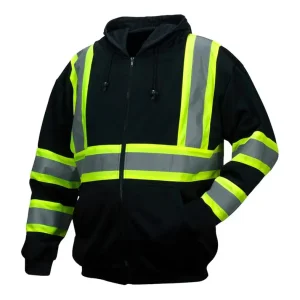
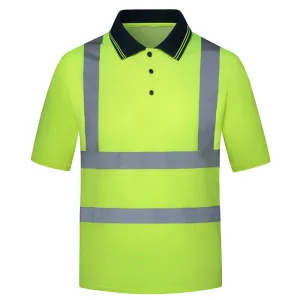
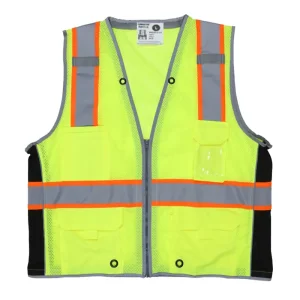
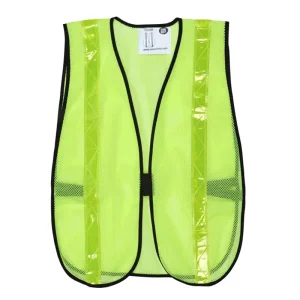
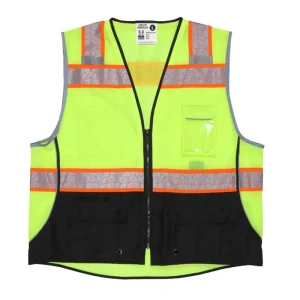
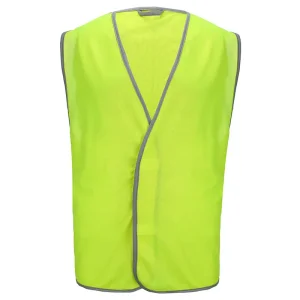
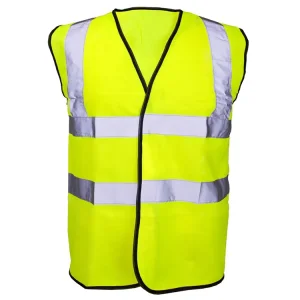
From digital tech packs and rapid prototyping to freight consolidation and customs clearance compliance.
Our specialized apparel CAD engineering department converts your artwork, pocket configurations, and branding guidelines into 3D digital renderings and physical pre-production samples within 3 to 5 business days.
Fabric samples are dispatched to accredited third-party laboratories (SGS, TÜV Rheinland, SATRA) to confirm ANSI/ISEA 107 and EN ISO 20471 compliance before mass cutting commences.
Operating high-efficiency continuous sewing assemblies with integrated inline Quality Gates. Capacity reaches over 300,000 safety vest units and 50,000 heavy outerwear jackets per month.
Supporting FOB Ningbo/Shanghai, CIF, DDP, and Amazon FBA fulfillment. Custom barcode labeling, polybag bagging, and heavy-duty corrugated export packaging tailored to distributor warehouse requirements.
Addressing key questions from B2B buyers, distributors, and safety managers regarding specifications, custom branding, and quality compliance.
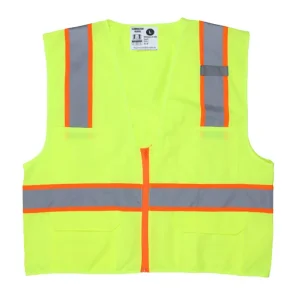
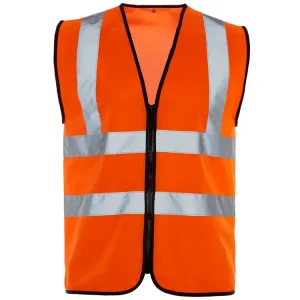
ANSI/ISEA 107-2020 Class 2 garments require a minimum of 775 sq. inches of fluorescent background material and 201 sq. inches of retroreflective trim, typically suitable for workers exposed to traffic exceeding 25 mph. Class 3 outerwear provides maximum coverage—requiring at least 1,240 sq. inches of background fabric and 310 sq. inches of reflective tape—and must feature full sleeves with retroreflective bands around the arms to ensure 360-degree body silhouette detection in vehicle headlights at high speeds (50+ mph).
Yes. Printing large corporate logos across fluorescent background fabric reduces the certified minimum visible fluorescent surface area. Under EN ISO 20471 standards, if a logo covers too much background material, the garment may drop from a Class 3 rating down to a Class 2 or Class 1. Yongkang Wow Safety provides free pre-production CAD evaluation to ensure custom screen printing or heat-transfer logos remain within designated non-certified print zones without compromising safety certification.
Standard high-visibility reflective glass-bead tapes are tested to maintain retroreflectivity over 25 wash cycles at 40°C (ISO 6330). However, our premium technical outerwear utilizes reinforced micro-prismatic or heavy-duty glass-bead tapes rated for 50 to 75 industrial wash cycles at 60°C, extending product longevity and providing maximum return on investment for commercial laundries and corporate safety programs.
For standard stock colors (Fluorescent Safety Yellow/Lime and Safety Orange), our MOQ starts as low as 500 units per style. For custom color matching, specialized flame-retardant anti-static treatings, or custom dye lots, our standard production MOQ is typically 1,000 to 2,000 units per order. Prototyping and sample development are available prior to contract execution.
Our waterproof Hi-Vis bomber jackets, raincoats, and parkas utilize 300D polyester Oxford base fabric coated with a microporous TPU or PU membrane. Key structural seams are sealed using automated heat-taped ultrasonic welding to achieve a Hydrostatic Head rating > 10,000mm H₂O. Internal breathable linings maintain a Water Vapor Permeability (WVP) index exceeding 8,000 g/m²/24h to prevent moisture buildup inside the jacket.
Fluorescent dyes are naturally susceptible to UV photodecomposition. To ensure long-lasting color visibility in harsh outdoor sunlight, all our polyester raw fabrics undergo UV-stabilizing treatment during the jet dyeing process. We certify high lightfastness ratings (ISO 105-B02 Grade 4+), ensuring garments maintain compliant chromaticity coordinates even after prolonged field exposure.
Depending on fabric construction: Safety vests woven from 100% synthetic fibers are classified under HS Code 6211.33 / 6211.43; insulated heavy jackets and parkas with polyurethane waterproof coatings fall under HS Code 6210.40 or 6210.50. Our experienced logistics department provides complete export documentation, including Certificate of Origin (Form A/Form E), commercial invoices, and packing lists to optimize import tariff processing.
Yes. We manufacture customized sizing lines tailored specifically to target markets—including standard North American sizing (S to 7XL), European slim-fit ergonomic specifications, and Australian AS/NZS 4602.1 garment dimensions. Our technical patternmakers create precise grading tables to ensure proper fit over heavy winter clothing or lightweight summer uniforms.