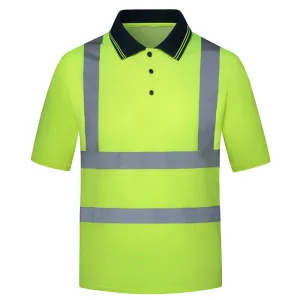
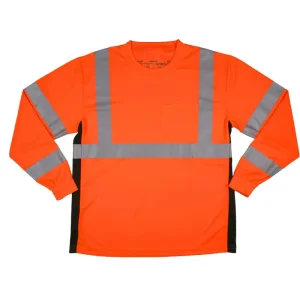
Explore our core catalog of certified high-visibility garments, engineered for high retroreflectivity, thermal insulation, and industrial laundering durability.
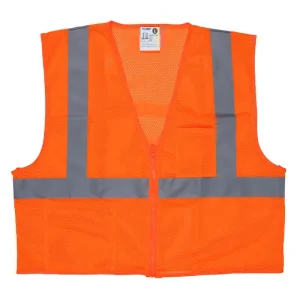
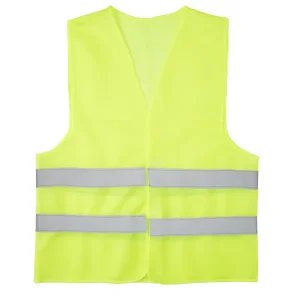
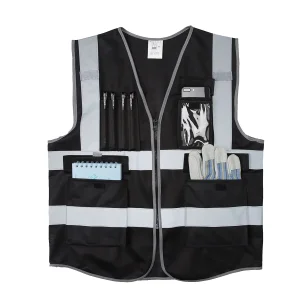
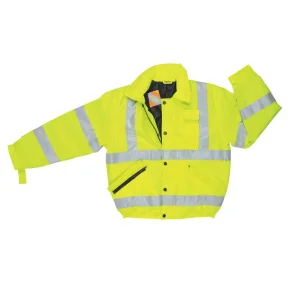
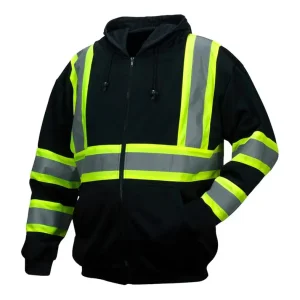
Navigating the shift from traditional safety vests to high-performance thermal Personal Protective Equipment (PPE) across cold-climate industrial sectors.
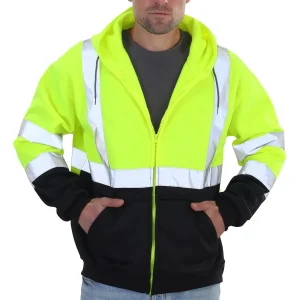
In modern industrial procurement, the demand for high-visibility thermal workwear has expanded far beyond basic waistcoats and lightweight vests. Industrial safety managers, procurement directors, and international distributors increasingly recognize that worker compliance and thermal comfort directly dictate job site efficiency and accident reduction. Wholesale fleece hi vis hoodies sit at the intersection of thermal regulation, retroreflective safety compliance, and ergonomic mobility.
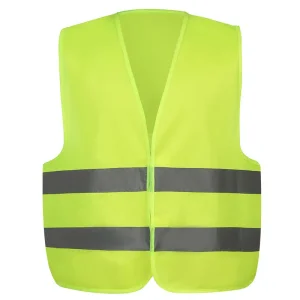
Across North America, Northern Europe, and Australasia, occupational safety regulations—governed by authorities such as OSHA in the United States and the European Agency for Safety and Health at Work (EU-OSHA)—mandate strict adherence to high-visibility standards like ANSI/ISEA 107-2020 and EN ISO 20471:2013+A1. As extreme weather events become more frequent and cold-weather shift work increases in sectors like cold-chain logistics, highway infrastructure, and offshore energy, standard polyester vests worn over bulky winter coats often prove restrictive, unsafe, and non-compliant.
Global standards now enforce strict chromaticity and retroreflectivity limits after multiple industrial laundering cycles. Compliance is no longer just about bright colors—it requires persistent photometric integrity.
Heavyweight 280–320 GSM polar fleece replaces multi-layered bulky apparel. Workers gain unrestricted arm movement while benefiting from high clo-value thermal insulation in sub-zero working conditions.
B2B buyers require OEM flexibility, including private labeling, specialized pockets for digital devices, anti-pilling treatments, and custom flame-retardant (FR) finishes catered to local enterprise needs.
Deep technical specification breakdown of high-visibility fleece construction, anti-pilling chemistry, and retroreflective film bonding technology.
Our fleece hi-vis hoodies utilize 100% spun polyester polar fleece engineered with a dense brushed interior and a smooth, low-pill exterior face. The microscopic air pockets trapped within the brushed fleece fibers yield an exceptional clo-value (thermal resistance rating), insulating workers against wind chill without adding excessive weight.
Traditional hi-vis sweatshirts feature solid stitched retroreflective tape. While functional, solid tape restricts fabric stretch and causes discomfort during physical labor. We specialize in advanced segmented heat-transfer thermal films.
| Parameter / Specification | Standard Fleece Hoodie | Heavyweight Professional Hi-Vis Hoodie | Windproof Laminated Hi-Vis Softshell Fleece |
|---|---|---|---|
| Fabric Weight (GSM) | 220 - 250 GSM | 300 - 340 GSM | 350 - 380 GSM (3-Layer Laminated) |
| Thermal Insulation (Clo Value) | 0.8 - 1.1 Clo | 1.5 - 1.8 Clo | 2.1 - 2.4 Clo |
| Retroreflective Tape Type | Generic TC Solid Tape | 3M™ / Reflomax Segmented Thermal Film | High-Glass Micro-bead Segmented Heat Transfer |
| Fluorescent Chromaticity | Basic Yellow / Orange Dye | CIE 1931 Standard Lime-Yellow & Red-Orange | UV-Resistant Fluorescent Dye (Grade 4-5 Colorfastness) |
| Industrial Wash Cycle Limit | 15 Cycles @ 40°C | 25 - 50 Cycles @ 60°C | 50+ Cycles @ 60°C (Industrial Laundering Grade) |
| Dirt-Masking Bottom Panel | Optional | High-Density 300D Black/Navy Oxford Accent | Reinforced Cordura® or 600D Abrasion Panel |
Detailed compliance breakdown across major international regulatory frameworks for high-visibility garments.
Mandates minimum background fabric area and reflective tape placement. Type R Class 3 hoodies require at least 1,240 sq in of fluorescent background fabric and 310 sq in of retroreflective tape with full sleeve coverage to ensure 360-degree night visibility.
European standard governing high-visibility clothing. Class 3 requires 0.80 m² of background material and 0.20 m² of retroreflective tape. Fleece hoodies engineered for the EU market feature strict luminance factor controls (\(\beta \ge 0.70\) for fluorescent yellow).
Specific standard for the UK rail network. Requires precise high-visibility orange dye (Chromaticity coordinates falling within specified boundaries) to ensure distinction against green vegetation along railway tracks.
Tailoring high-visibility fleece hoodie specifications to the severe operational demands of diverse working environments.
Inside freezer facilities operating between -18°C and -25°C, workers perform high-velocity forklift maneuverings and order picking. Standard safety vests over bulky jackets impede agility.
Recommended Spec: 320 GSM heavy polar fleece hoodie with quarter-zip or full-zip front, elastic rib cuffs, and black bottom panels to mask conveyor dirt and grease while preserving upper chest Class 2/3 visibility.
Road crews operating near high-speed vehicle traffic require 360° retroreflectivity under vehicle headlight beams from distances exceeding 300 meters.
Recommended Spec: ANSI Class 3 Fleece Hoodie with dual 2-inch wide segmented heat-transfer reflective bands around the torso and horizontal/vertical arm striping, paired with high-contrast fluorescent lime-green base fabric.
Workers encounter harsh salt air, high winds, and moisture. Metal zippers corrode, and traditional cotton-blend fleece becomes waterlogged.
Recommended Spec: Synthetic 100% hydrophobic polyester fleece featuring heavy-duty YKK plastic resin zippers, storm flap closures, double-stitched wind-resistant hood, and stain-repellent surface treatments.
Heavy machinery operators and underground technicians work around tight clearances and heavy grease. Tears and abrasions are frequent.
Recommended Spec: Heavy-duty fleece hoodies reinforced with 300D Oxford fabric across forearm abrasion zones, reinforced radio loops, dual mic tabs, and heavy-thread bartack stitching at all stress points.
Unlocking procurement efficiency through vertical industrial integration, automated garment manufacturing, and global export infrastructure.
Located in Yongkang, Jinhua City, Zhejiang Province, our facility operates at the center of China’s premium textile and safety equipment ecosystem. Dyeing mills, reflective tape manufacturers, zipper suppliers, and packaging hubs operate within a 30-mile radius, dramatically cutting production lead times.
We deploy automated fabric spreading equipment and high-precision CAD laser cutters. This guarantees pattern accuracy across all sizes (S to 6XL), maximizes fabric yield to lower unit prices, and eliminates manual cutting discrepancies.
From initial TECH PACK review, fabric lab-dip color matching under D65 light sources, sample creation within 5 days, to mass production in 20–25 days, our full OEM/ODM workflow ensures seamless order execution for global enterprise buyers.
Exploring the next frontier of high-visibility thermal workwear technology—from circular sustainability to smart safety integration.
As corporate ESG directives mandate sustainable procurement, our R&D team has developed 100% post-consumer recycled polyester fleece derived from recycled plastic bottles. Certified under the Global Recycled Standard (GRS), our rPET fleece achieves identical GSM weight, tensile strength, and warmth ratings as virgin polyester while reducing carbon footprints by up to 35%.
In total darkness or fog where passive retroreflective tape requires an external light source (vehicle headlights) to illuminate, passive gear can fall short. Our next-generation hoodies integrate ultra-thin, flexible LED light strips powered by lightweight rechargeable lithium micro-packs, offering active 500-meter visibility independent of external ambient light.
By incorporating graphene nano-coatings onto the inner fleece grid, we enhance heat distribution across the torso. Graphene absorbs body heat and redistributes it evenly, while simultaneously dissipating static electricity build-up—a critical feature for workers operating around sensitive electronics or combustible dust environments.
Phasing out perfluorinated chemicals (PFCs) is crucial for environmental safety. Our lab-tested bio-based DWR coatings utilize plant-based matrices that cause water, oil, and mud to bead off the fleece face fabric without compromising breathability or skin safety.
Addressing technical, regulatory, and commercial sourcing inquiries for wholesale buyers and compliance managers.
For moderate cold (0°C to 10°C), a 280 GSM polar fleece provides excellent warmth without excessive bulk. For severe cold (-10°C to 0°C) or static cold-storage work, we recommend 300 to 340 GSM heavyweight fleece or a 350 GSM 3-layer softshell laminated fleece with windproof TPU membrane technology.
ANSI Class 2 garments require a minimum of 775 sq in of background fabric and 201 sq in of retroreflective material, suitable for traffic speeds up to 25-50 mph. ANSI Class 3 requires at least 1,240 sq in of background fabric and 310 sq in of reflective tape, requiring full 360-degree visibility with retroreflective striping on sleeves. Class 3 is mandatory for high-risk workers near traffic exceeding 50 mph or in hazardous construction zones.
Fleece is an elastic, stretchable knit fabric. Solid stitched reflective tape does not stretch, which leads to uncomfortable pulling, seam tension, and premature peeling or cracking of the reflective material during movement. Segmented thermal transfer tape features micro-gaps that flex naturally with the fleece fabric, extending garment lifespan, enhancing breathability, and improving wearer mobility.
Dark-colored panels on the lower torso and sleeve cuffs are engineered to mask dirt, oil, and grime in high-wear areas. However, the remaining fluorescent yellow/orange material must still meet the absolute minimum surface area requirements (e.g., 1,240 sq in for ANSI Class 3). Our pattern designers calculate exact surface area ratios prior to cutting to guarantee full certification compliance.
Our standard MOQ for custom wholesale fleece hi-vis hoodies is 500 units per colorway/design. Standard sample lead time is 5 to 7 business days upon tech pack approval. Bulk production requires 20 to 30 days depending on order volume and custom ornamentation (e.g., embroidery, screen printing, custom hangtags).
We utilize high-grade disperse dyes combined with high-temperature pressure dyeing processes. Fabrics undergo colorfastness testing according to ISO 105 standards, achieving Grade 4-5 colorfastness to laundering, perspiration, and rubbing. This ensures the fluorescent yellow or orange retains its precise chromaticity coordinates over repeated industrial wash cycles.
Explore additional specialized safety clothing, shirts, jackets, rainwear, and protective accessories from our manufacturing inventory.