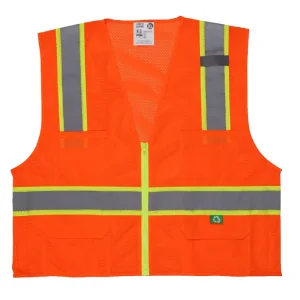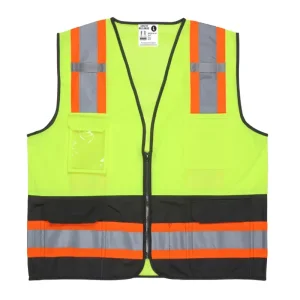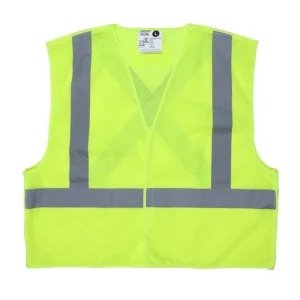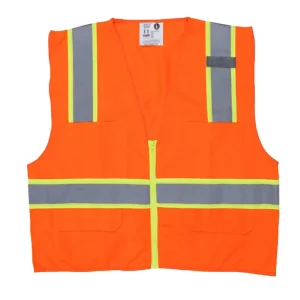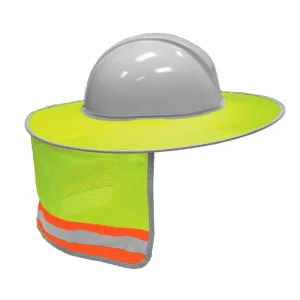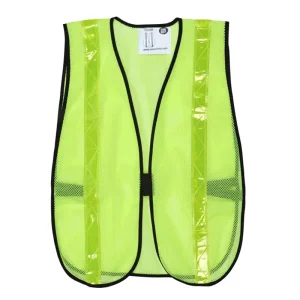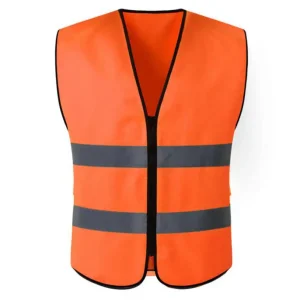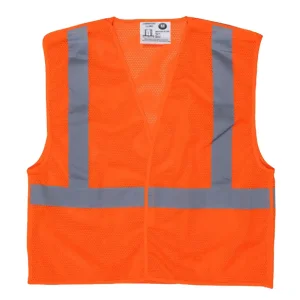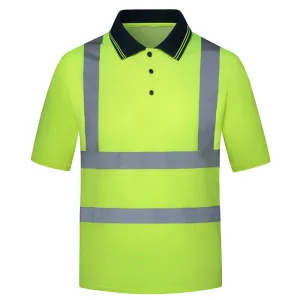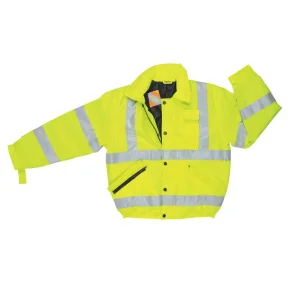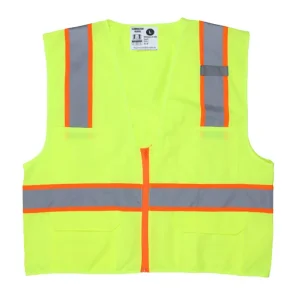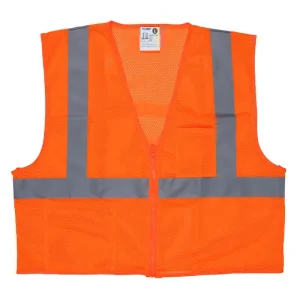
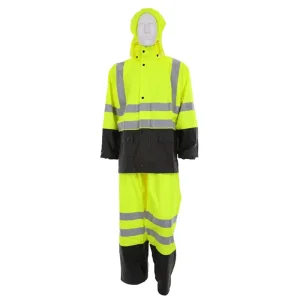
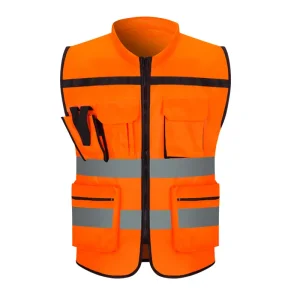
In the global industrial Personal Protective Equipment (PPE) market, the operational demand for all-weather, high-visibility workwear has accelerated at an unprecedented rate. Procurement directors, enterprise safety compliance officers, and international distributors no longer evaluate safety vests strictly by basic retroreflective tape placement or standard fluorescent background fabrics. The contemporary paradigm demands waterproof safety vest manufacturing that reconciles extreme meteorological protection with breathable micro-porous membrane technology, ultra-high photometric reflectivity under wet condition scatter, and rugged mechanical durability.
As heavy civil infrastructure, offshore logistics, highway maintenance, and emergency response operations encounter increasingly volatile weather patterns globally, the vulnerability of non-waterproof PPE becomes a critical liability. Standard hi-vis vests quickly saturate under torrential rain, increasing garment weight, causing severe thermal discomfort, and significantly degrading the photometric efficiency of glass-bead retroreflective materials. Partnering with a specialized China waterproof safety vest factory enables global enterprises to leverage advanced fabric lamination, heat-sealed hot-melt seam taping, and smart automation to mitigate operational risk while maintaining optimal cost efficiency.
Integration of microporous Thermoplastic Polyurethane (TPU) or Polyurethane (PU) membranes laminated onto high-tenacity 300D/600D Oxford polyester fabrics, achieving hydrostatic pressure resistance exceeding 10,000 mm H₂O.
Deploying specialized micro-prismatic reflective materials engineered to maintain high coefficients of retroreflection (RA ≥ 330 cd/lx·m²) even under direct water film coverage and storm conditions.
Engineered structural cut lines with reinforced stress points, breakaway safety zippers, and dynamic ventilation channels to eliminate heat accumulation during intense manual labor.
Achieving absolute liquid water barrier performance without sacrificing breathability requires a deep understanding of polymer chemistry and textile engineering. Leading China waterproof safety vest factories utilize multi-layer composite structures engineered for high moisture vapor transmission alongside impenetrable water resistance.
Waterproof performance is measured by the Hydrostatic Head test (AATCC 127 / ISO 811), quantifying the water pressure (in millimeters of water column) that a fabric can withstand before leakage occurs. Premium safety vests produced in advanced Chinese facilities achieve ratings between 5,000mm H₂O to 20,000mm H₂O.
Simultaneously, worker comfort mandates high breathability. By applying hydrophilic TPU coatings or hydrophobic PTFE membranes, moisture vapor from sweat escapes via molecular diffusion (MVTR ratings exceeding 5,000 g/m²/24h according to JIS L1099 B1), preventing inside condensation buildup during rigorous physical exertion.
The primary point of failure in any waterproof garment is not the fabric surface, but the needle punctures created during stitching. A top-tier China waterproof safety vest factory deploys fully automated hot-air seam-sealing machinery.
Three-layer or two-layer hot-melt polyurethane seam tapes are applied under precise temperature (typically 400°C–550°C), pressure, and speed parameters. This completely seals all shoulder, side, and pocket seams, creating a continuous, monolithic liquid barrier capable of withstanding industrial laundering cycles without delamination.
| Fabric Type & Specification | Hydrostatic Head Rating | Breathability (MVTR) | Abrasion Resistance (Martindale) | Optimal Application Scenario |
|---|---|---|---|---|
| 300D Oxford Polyester + PU Coating | 3,000mm - 5,000mm H₂O | 1,500 - 3,000 g/m²/24h | > 15,000 Rubs | Standard Traffic Control, Civil Construction |
| 300D Oxford + Laminated TPU Membrane | 10,000mm - 15,000mm H₂O | 5,000 - 8,000 g/m²/24h | > 25,000 Rubs | Heavy Infrastructure, Port & Dock Operations |
| 600D Ripstop Oxford + PTFE Membrane | 20,000mm+ H₂O | > 10,000 g/m²/24h | > 50,000 Rubs | Extreme Weather Offshore, Tactical Emergency Response |
| Recycled PET (GRS Certified) + Bio-PU | 8,000mm - 10,000mm H₂O | 4,000 - 6,000 g/m²/24h | > 20,000 Rubs | Eco-Conscious Corporate ESG Fleet Sourcing |
The global safety equipment supply chain demands speed, consistency, strict quality control, and scalable capacity. OEM and ODM buyers sourcing from a leading China waterproof safety vest factory benefit from an ultra-integrated industrial ecosystem situated in primary manufacturing hubs such as Zhejiang, Jiangsu, and Shandong.
Computerized nesting algorithms maximize fabric utilization (reducing scrap waste by up to 12%), while automated multi-layer laser cutting systems guarantee dimensional accuracy down to 0.1mm tolerance for complex pocket and seam layouts.
In-line digital spectrophotometers check color consistency under ISO 105-B02 lightfastness standards, while pneumatic hydrostatic testers continuously sample sealed seams on the production line to ensure zero defect leakage.
Direct integration with local yarn spinning, dyeing, membrane lamination, and reflective tape factories reduces procurement lead times by 35%, offering unmatched agility for bulk contract orders.
For international buyers, non-compliance is not an option. Importing high-visibility safety vests into North America, Europe, or Australia requires precise adherence to regional safety standards. Professional Chinese factories provide complete technical documentation, SATRA/UL test reports, and factory audit credentials (BSCI, ISO 9001, SMETA).
Specifies requirements for high-visibility safety apparel. Waterproof safety vests typically fall into Type R (Off-Road/Roadway) Class 2 or Class 3, requiring minimum background fabric areas (775 in² for Class 2, 1240 in² for Class 3) and retroreflective tape width of at least 2 inches (50mm).
European standards require dual certification: EN ISO 20471 for high visibility (Class 1, 2, or 3 photometrics) and EN 343 for rain protection (evaluating Water Penetration Resistance Class 1-4 and Water Vapor Resistance Class 1-4).
Australian/New Zealand standards dictate garment design for Day/Night use (Class D/N). Waterproof vests must feature bio-motion pattern reflective tape layouts and fluorescent background materials tested under AS/NZS 1906.4 conditions.
Construction crews working on high-speed motorways in inclement weather require ANSI Class 3 waterproof safety vests with 360° retroreflective coverage. Heavy-duty radio mic tabs, multi-compartment tablet/tool pockets, and reinforced ID badge holders are critical ergonomic additions.
Harbor workers, deckhands, and container terminal crane operators operate under severe moisture and saltwater exposure. Waterproof safety vests with flame-retardant (FR) anti-static PU coatings prevent chemical degradation and mitigate static spark hazards.
Ground crews working near active aircraft runways encounter intense turbine spray and high-wind environments. Windproof, waterproof safety vests equipped with storm flaps over heavy-duty resin zippers ensure thermal retention and mechanical security.
First responders operating during hurricanes, floods, and night operations demand high-contrast LED illuminated or micro-prismatic waterproof vests with 5-point breakaway designs to prevent entanglements in debris.
When evaluating a prospective China waterproof safety vest factory, B2B procurement managers must perform rigorous technical audits beyond basic price-per-unit comparisons. Below is the standardized 5-step verification checklist deployed by global enterprise buyers:
Verify OEKO-TEX Standard 100, GRS (Global Recycled Standard) certificates for recycled polyester, and independent lab test reports for fluorescent dye colorfastness to light (ISO 105-B02 ≥ Grade 4).
Request hydro-tester destructive testing on factory sample seams. Ensure hydrostatic resistance across dynamic cross-seams matches or exceeds the flat fabric rating (min 5,000mm H₂O).
Ensure retroreflective tape (glass bead or micro-prismatic) is certified to maintain RA ≥ 100 cd/(lx·m²) after 25 to 50 industrial wash cycles at 60°C according to ISO 6330.
The high-visibility safety vest industry is undergoing a digital and ecological transformation. Smart safety garments integrated with active electroluminescent (EL) lighting strips, flexible solar panels, and wearable IoT environmental sensors represent the next horizon in occupational safety.