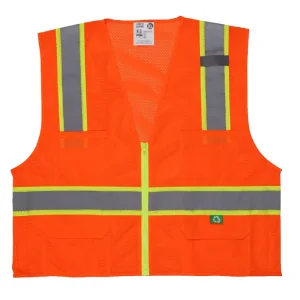
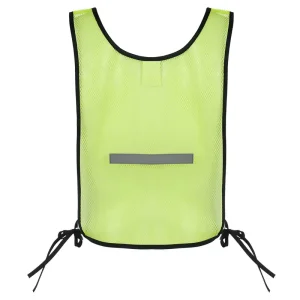
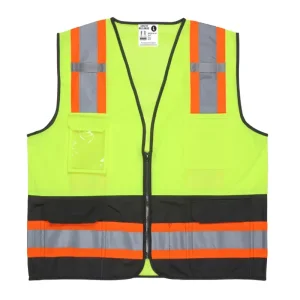
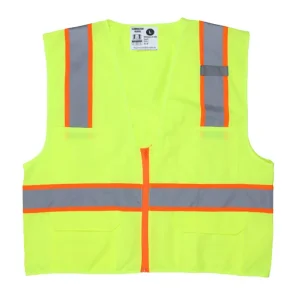
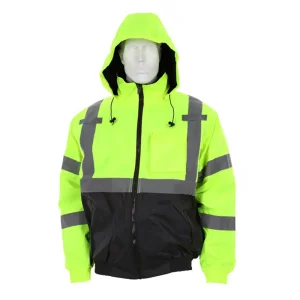
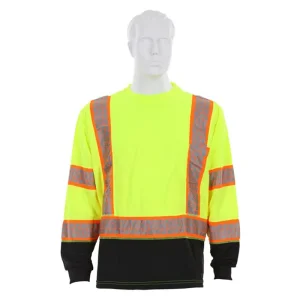
Explore our premium factory-direct safety garments integrated with high-coefficient retroreflective tapes engineered for extreme industrial performance.
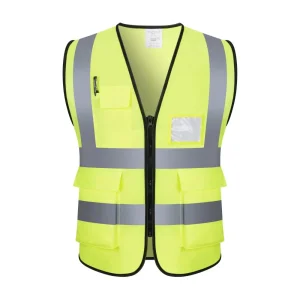
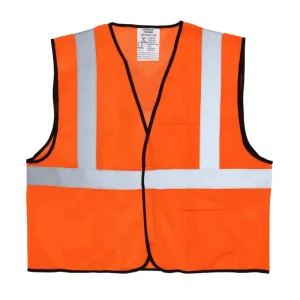
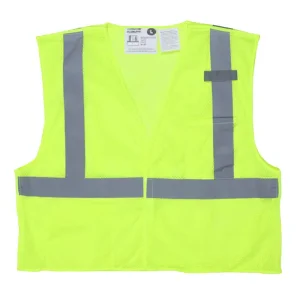
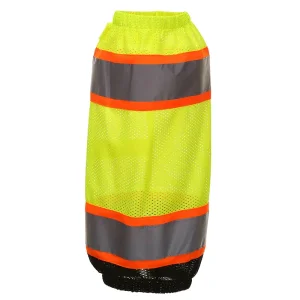
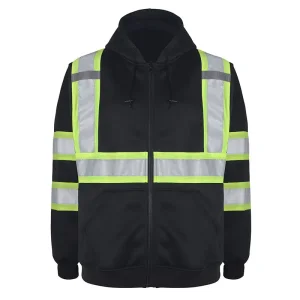
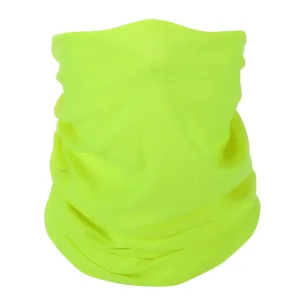
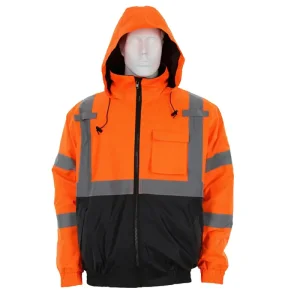
Understanding the optical physics, refractive indices, and material science driving high-visibility reflective strips for global occupational safety.
Utilizing high-index microscopic glass beads ($n \ge 1.93$) embedded in an acrylic resin matrix. Incidental light rays are focused onto a vacuum-deposited aluminum mirror backing, redirecting light directly back to the original source with minimal dispersion.
Constructed with precision-molded corner-cube prisms that bounce light off internal surfaces. Provides superior long-range entrance angle optics, making it essential for heavy machinery operators and high-speed highway environments.
Safety vest strips require specialized backing textiles depending on end-use application. Choices range from lightweight 100% polyester weaves to heavy flame-retardant aramid and stretchable TPU heat-transfer vinyl coatings.
Retroreflection differs fundamentally from diffuse reflection (found in normal white fabric) and specular reflection (found in standard flat mirrors). In diffuse reflection, light scatters in all directions; in specular reflection, light bounces off at an equal opposite angle. Retroreflective strips manufactured in leading Chinese facilities like Yongkang Wow Safety Products leverage catadioptric systems—combining refraction and specular reflection inside micro-spheres—to force parallel ray returning paths. This guarantees that vehicle headlamp illuminance returning to a driver's eyes at 300 meters is maximized, providing up to 8 additional seconds of braking reaction time.
Why sourcing safety vest reflective strips from specialized manufacturing clusters in Zhejiang, China delivers unmatched cost efficiencies, technical consistency, and scalability.
China's safety equipment hubs (such as Yongkang and Jinhua in Zhejiang Province) integrate raw chemical synthesis, glass bead manufacturing, vacuum metallization, polyester weaving, automated slitting, and garment assembly within a 30-kilometer radius.
By leveraging continuous high-speed roll-to-roll coating lines, Chinese manufacturers minimize unit cost overhead while maintaining rigorous quality control across millions of linear meters of retroreflective tape produced per month.
With fully equipped inline laser slitting and screen-printing facilities, OEM suppliers can rapidly prototype custom strip patterns (such as two-tone lime/orange strips with custom corporate logo printing) within 48 hours.
Comprehensive comparative breakdown of international safety requirements for reflective strips and high-visibility garments across North America, Europe, and Australia.
| Standard Code | Geographic Region | Minimum Strip Reflectivity ($R_A$) | Primary Application Focus | Compliance Test Key Parameters |
|---|---|---|---|---|
| ANSI/ISEA 107-2020 | North America (USA/Canada) | $\ge 330 \text{ cd/lx/m}^2$ (Level 2) | Occupational safety, road construction, municipal utilities | Photometric test after 25 wash cycles, flexing at -30°C, rainfall exposure |
| EN ISO 20471:2013 | European Union & UK | $\ge 500 \text{ cd/lx/m}^2$ (Class 2 Tape) | High-risk traffic hazards, railways, industrial workwear | ISO 6330 wash durability, dry cleaning resistance, abrasion resistance |
| AS/NZS 1906.4:2010 | Australia & New Zealand | $\ge 400 \text{ cd/lx/m}^2$ Class R | Mining operations, outdoor construction, harsh UV exposure | Xenon arc accelerated weathering, colorfastness, extreme UV stability |
| CSA Z96-15 | Canada | $\ge 330 \text{ cd/lx/m}^2$ | Cold climate logistics, oil & gas sector safety garments | Low-temperature impact test (-40°C), retroreflection retention |
| NFPA 2112 / EN 11612 | Global Industrial Safety | Varies based on flame backing | Electric utility arc-flash protection, petrochemical plants | Flame propagation test (ISO 15025), thermal performance index (TTP) |
A reputable safety vest strip factory in China maintains rigorous in-house physical laboratory testing. Quality control engineers conduct spectrophotometric evaluation using standardized Retroreflectometer devices (0.2° observation angle, -4° entrance angle). Micro-glass bead adhesion is validated through Martindale abrasion machines across 5,000 continuous cycles, verifying that the aluminum mirror coating does not flake off or degrade when exposed to harsh industrial wash conditions.
A strategic framework for procurement directors, brand owners, and safety equipment importers auditing Chinese safety vest strip manufacturers.
Verify whether the factory uses 100% virgin polyester fabric backing or recycled PET (GRS certified). Check resin binder chemistry: acrylic resins offer superior weatherproofing compared to low-cost vinyl binders.
Inquire about wash cycle guarantees. Standard economy strips withstand 10 to 15 domestic wash cycles at 40°C. Premium industrial-grade reflective strips withstand 50+ wash cycles at 60°C and 30+ dry-cleaning cycles.
Ensure the supplier possesses valid ISO 9001 quality system accreditation, ISO 14001 environmental certification, and BSCI or SEDEX social compliance audits to guarantee ethical manufacturing practices.
Exploring the next generation of smart safety apparel, sustainable materials, and active illumination integration entering global markets.
Combining retroreflective micro-beads with strontium aluminate glow-in-the-dark pigments. These strips store ambient UV rays during the day and emit active glow in total dark conditions even without headlights.
Leading Chinese manufacturers are transitioning to 100% GRS (Global Recycled Standard) post-consumer recycled PET bottles for backing fabrics, reducing carbon footprints by over 40% for ESG-focused European buyers.
Integrating flexible, ultra-thin micro-LED light channels directly within retroreflective tape channels, powered by rechargeable lithium-ion power packs for maximum active nighttime safety.
Specific performance demands placed on safety vest strips across specialized industrial sectors.
Requires high daytime contrast (Fluorescent Lime-Yellow or Fluorescent Orange background) combined with 2-inch wide silver retroreflective strips certified to ANSI Class 2 or Class 3 standards for vehicular speeds exceeding 50 mph.
Demands SOLAS (Safety of Life at Sea) certified marine retroreflective strips with marine-grade adhesives, saltwater exposure tolerance, and high resistance to hydrostatic pressure.
Requires flame-retardant (FR) reflective strips built on 100% Meta-Aramid or FR Treated Cotton backings that pass ISO 11612 and NFPA 70E thermal performance requirements without melting or dripping under heat exposure.
Clear, technical answers to common questions regarding safety vest strip manufacturing, customization, ordering parameters, and international export procedures.
Sew-on reflective strips feature a flexible fabric backing (polyester, TC cotton, or aramid) that is stitched onto garments using industrial sewing machines. Heat-transfer vinyl (HTV) strips feature a hot-melt adhesive backing that is heat-pressed directly onto synthetic fabrics (such as 100% polyester mesh or nylon) at 140°C - 160°C. Sew-on strips offer superior tear strength for heavy outerwear, while HTV strips provide lightweight, seamless aesthetics preferred in sport and athletic safety gear.
Top factories like Yongkang Wow Safety Products Co., Ltd. operate certified optical laboratories equipped with retroreflectometer testing instruments, colorimetric spectrophotometers, and tensile strength testers. Every batch of reflective fabric undergoes strict pre-shipment sampling to ensure the retroreflective coefficient ($R_A$) exceeds $330 - 500 \text{ cd/lx/m}^2$. Formal test certificates issued by third-party bodies (such as SATRA, TÜV Rheinland, or SGS) are routinely provided with export documentation.
Customization parameters include strip width (standard 2-inch / 5cm, or 3-inch / 7.5cm), backing fabric color (Fluorescent Lime-Yellow, Orange-Red, Black, Navy Blue), custom screen-printed logos on the reflective surface, two-tone color backing layouts, and laser-punched breathable perforations designed for high-heat working environments.
Standard reflective strips in stock widths typically have an MOQ of 1,000 meters. Fully custom OEM orders (custom colors or printed pattern backings) generally require an MOQ of 3,000 to 5,000 meters. Standard production lead times range from 10 to 18 business days after sample sign-off, supported by streamlined port logistics out of Ningbo or Shanghai.
Reflective degradation occurs primarily when harsh alkaline laundry detergents or high-friction tumble drying wear down the exposed micro-glass beads embedded on the surface. To maximize durability, quality factories apply clear protective polyurethane (PU) over-coatings that lock the glass beads into place, enabling garments to sustain up to 50 industrial washing cycles at 60°C without significant loss of photometric candlepower.
Discover our extended line of high-visibility outerwear, hoodies, waterproof rainwear, and accessories tailored for international industrial procurement.