Precision-engineered reflective apparel manufactured under ISO 9001 and certified against international safety standards (ANSI/ISEA 107-2020 & EN ISO 20471:2013).
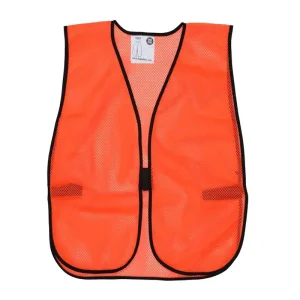
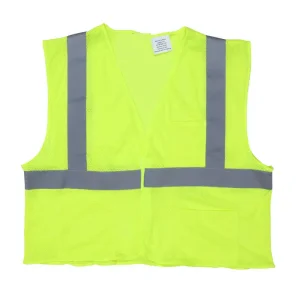
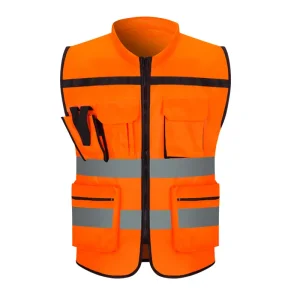
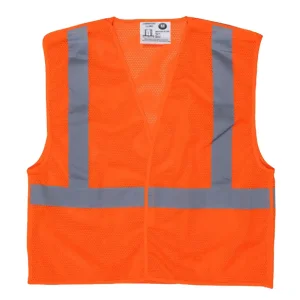
The global High-Visibility Personal Protective Equipment (PPE) market is undergoing a structural paradigm shift. Driven by increasingly stringent municipal safety mandates, expanding infrastructure development in North America and Western Europe, and rigorous workplace safety enforcement by agencies such as the U.S. Occupational Safety and Health Administration (OSHA) and the European Agency for Safety and Health at Work (EU-OSHA), the demand for high-performance reflectorized safety vests has surpassed traditional commoditized bounds. Sourcing officers and industrial distributors no longer view safety apparel merely as price-sensitive garments, but as mission-critical compliance assets engineered to reduce workplace fatalities and mitigate corporate liability.
China's positioning as the dominant global hub for reflectorized safety vest suppliers and factories is rooted in deep structural advantages: vertically integrated textile clusters, advanced polymer chemistry for retroreflective tape production, automated computerized stitching systems, and unmatchable supply chain agility. Specialized manufacturing centers—specifically within Zhejiang province, including Yongkang and Jinhua—house concentrated industrial ecosystems capable of orchestrating everything from raw yarn spinning and fluorescent pigment dyeing to high-precision micro-prismatic tape lamination and laboratory photometry testing.
Modern optical requirements demand more than basic high-contrast color matching. Standard ISO 20471 and ANSI/ISEA 107-2020 mandate minimum luminance factors ($Y \ge 0.70$ for yellow, $Y \ge 0.40$ for orange-red) alongside strict retroreflective performance metrics ($R_A \ge 330\text{ cd}/(\text{lx}\cdot\text{m}^2)$ for Level 2 retroreflective material under standard observation angles). Leading Chinese suppliers now integrate continuous photometric monitoring during production to guarantee compliance after repeated industrial laundering cycles.
Understanding the performance of a high-visibility safety vest requires a rigorous evaluation of the optical physics governing retroreflection and the polymer chemistry of background fabrics. Retroreflection occurs when light rays striking a surface are reflected directly back toward their original source, regardless of the incident angle of illumination. In industrial safety vests, this is achieved via two primary technological pathways:
Utilizes microscopic spherical glass beads embedded within a synthetic resin matrix. Light entering the bead is refracted, reflected off a vapor-deposited aluminum back surface, and refracted back toward the light source. Glass bead reflective tapes offer consistent wide-angle performance, superior flexibility, and cost efficiency for Class 2 utility vests.
Employs millions of microscopic corner-cube prisms molded into high-grade poly-vinyl chloride (PVC) or polycarbonate sheets. Light undergoes Total Internal Reflection (TIR) off three mutually perpendicular prism faces. Micro-prismatic tapes deliver extraordinary retroreflective intensity ($R_A > 500\text{ cd}/(\text{lx}\cdot\text{m}^2)$) and retain reflectivity under severe rain and moisture conditions.
Background fabrics utilize 100% virgin polyester (warp-knitted tricot or breathable bird's-eye mesh) infused with specialized optical brighteners and chromophores. Fluorescent dyes absorb invisible ultraviolet radiation (300-400 nm) and re-emit it as visible light (500-600 nm), creating extreme daytime luminance even under overcast, dawn, or dusk conditions.
The table below outlines the core material parameters adhered to by certified Chinese safety vest manufacturers for premium B2B deployments:
| Parameter | ANSI/ISEA 107-2020 Standard | EN ISO 20471:2013 Standard | China Wow Safety Factory Standard |
|---|---|---|---|
| Background Fabric Area (Class 2) | $\ge 0.50\text{ m}^2$ ($775\text{ in}^2$) | $\ge 0.50\text{ m}^2$ | $\ge 0.55\text{ m}^2$ (Safety margin guaranteed) |
| Retroreflective Material Area | $\ge 0.13\text{ m}^2$ ($201\text{ in}^2$) | $\ge 0.13\text{ m}^2$ | $\ge 0.16\text{ m}^2$ (Includes dual 2" waist & shoulder) |
| Initial Retroreflection ($R_A$) | $\ge 330\text{ cd}/(\text{lx}\cdot\text{m}^2)$ | $\ge 330\text{ cd}/(\text{lx}\cdot\text{m}^2)$ | $\ge 450-500\text{ cd}/(\text{lx}\cdot\text{m}^2)$ (Glass bead / Prism) |
| Color Fastness to Washing | Grade 4.0 Minimum | Grade 4.0 Minimum | Grade 4.5+ (High-temp disperse dye) |
| Tensile Strength (Woven/Knit) | $\ge 60\text{ N}$ bursting strength | $\ge 100\text{ N}$ tensile force | $\ge 150\text{ N}$ (Reinforced polyester yarn) |
| Industrial Laundering Durability | 25 Cycles @ 40°C | 25 Cycles @ 60°C | 50+ Cycles @ 60°C (ISO 6330 / ISO 15797) |
Global importers and procurement officers face significant regulatory complexity when sourcing protective workwear. Leading manufacturers in China establish rigorous Quality Assurance (QA) protocols to ensure seamless custom clearing and compliance in target destinations:
The American National Standard for High-Visibility Safety Apparel classifies garments into Performance Classes based on worker exposure to traffic speed and environmental hazards:
Under EU PPE Regulation 2016/425, safety vests imported into the European Economic Area (EEA) must hold valid EU Type-Examination Certificates issued by notified bodies (such as SATRA, SGS, TÜV, or Aitex). EN ISO 20471 defines performance in three classes based on mandatory visual area ratios, requiring strict ergonomic compliance and 360° visibility around the human body.
For oil & gas, petrochemical processing, and electrical utility work, standard polyester safety vests present a severe melting hazard under arc flash or flash fire conditions. Advanced factories in Yongkang customize specialized FR safety vests combining 100% Modacrylic fibers, Nomex blends, or FR-treated cotton meeting NFPA 2112, ASTM F1506, and EN ISO 11612 specifications.
The competitiveness of China's safety vest industry is driven by geographical industrial clustering. Yongkang WOW Safety Products Co., Ltd., situated in Jinhua City, Zhejiang, represents the pinnacle of localized industrial ecosystem efficiency. Within a 50-kilometer radius, factories maintain real-time access to raw material yarn spinning, high-capacity dyeing mills, precision trim component manufacturers (zippers, hook-and-loop fasteners, bias binding), and certified reflective media coaters.
By operating modern facilities exceeding 6,000 m² with over 150 skilled sewing technicians, production cycles are streamlined. Automated CAD pattern cutting reduces fabric waste by 12%, while computerized multi-needle stitching lines maintain precise stitch density (minimum 8-10 stitches per inch) for durability.
Bulk raw material stockpiling of ANSI-compliant fluorescent yellow and orange polyester mesh enables accelerated production runs. Emergency municipal safety orders or large contract tenders of 100,000+ units can be executed within 15-20 business days.
From silk-screen logo application, heat-transfer vinyl reflective branding, multi-functional pocket arrangements (surveyor configurations, tablet pockets, radio mic tabs), to custom Pantone-matched contrast trim, factory-direct OEM capabilities accommodate custom buyer specs.
High-visibility safety vests must be engineered to suit specific operational environments, weather patterns, and regional hazard profiles. Modern manufacturers categorize deployment scenarios into five distinct industrial domains:
Requires ANSI Class 2 or Class 3 vests with 360° retroreflective coverage. Features heavy-duty resin zippers, reinforced webbing, and high-visibility contrast backing tapes (4.5" lime/orange combinations) to maximize visual pop in high-speed traffic zones.
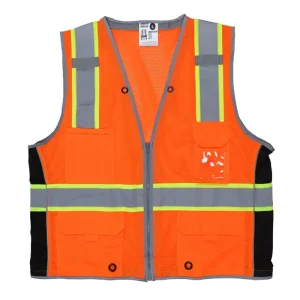
Demands specialized multi-pocket surveyor vests. Includes 6 to 9 dedicated pockets, padded collar cushions, grommets for tape dispensing, clear ID card windows, tablet-sized rear zipper pockets, and dual mic tabs for radio equipment.
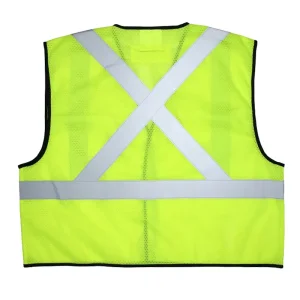
Requires 5-Point Breakaway safety vests utilizing heavy-duty hook-and-loop closures across shoulders, sides, and front. If caught in moving machinery or train doors, the vest instantly detaches to protect the wearer from entanglement. Features mandatory X-Back reflective patterns for directional identification.
The convergence of wearable technology, IoT sensor integration, and eco-friendly polymer chemistry is driving the next evolution of reflectorized safety apparel. Advanced Chinese manufacturing facilities are leading R&D efforts across three transformative vectors:
Passive retroreflective tape requires an external light source (vehicle headlights) to illuminate. Smart safety vests now incorporate integrated ultra-thin, washable LED fiber optic piping powered by rechargeable lithium-ion micro-batteries, providing active self-illumination up to 500 meters in pitch-black zero-light conditions.
To meet global ESG mandates, factories are replacing virgin petroleum-based polyester with 100% Post-Consumer Recycled Polyester (rPET) derived from ocean plastics and recycled PET bottles. Certified under the Global Recycled Standard (GRS) and OEKO-TEX® Standard 100, these eco-fabrics retain 100% of standard tensile and colorfastness properties.
Embedded heat-sealed RFID chips enable automated fleet management for large construction firms and industrial facilities. Chips track laundering frequency, inspect compliance status, log user assignment, and alert safety managers when a garment reaches its maximum operational lifespan.
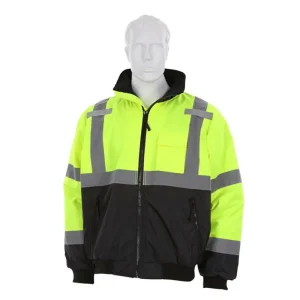
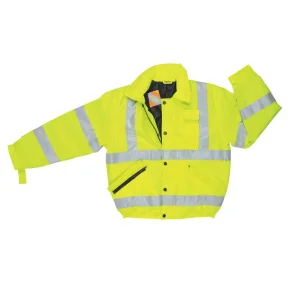
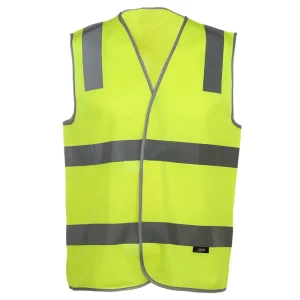
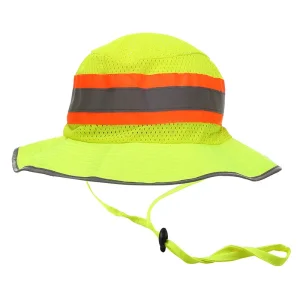
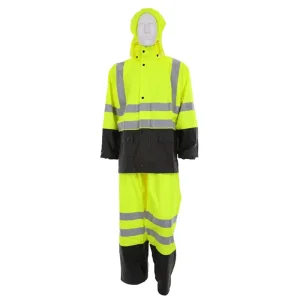
Expanded safety apparel line including long-sleeve vests, thermal sweatshirts, weather-proof bomber jackets, and high-visibility field accessories.
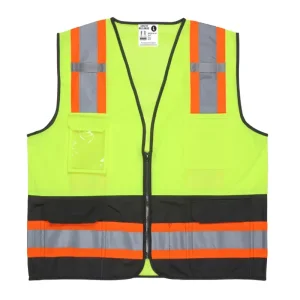
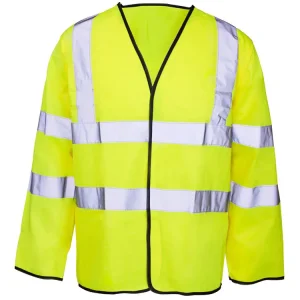
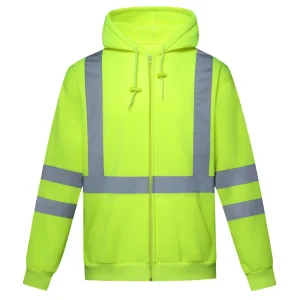

Expert insights covering compliance certification, customization parameters, factory audits, and global shipping logistics.