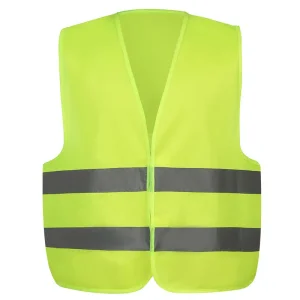
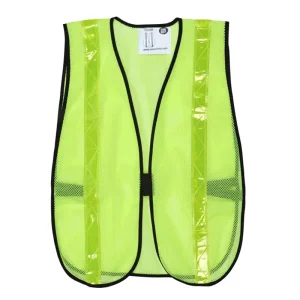
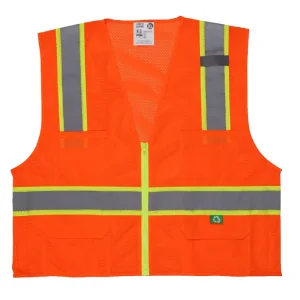
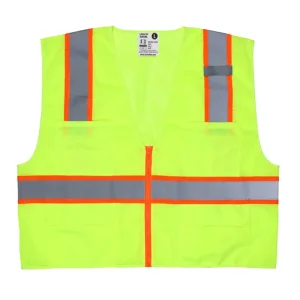
Certified high-performance reflective safety garments engineered for railway workers, track inspectors, and infrastructure maintenance crews.
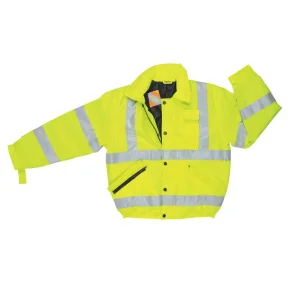
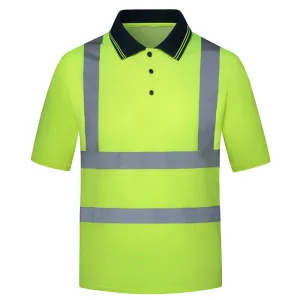
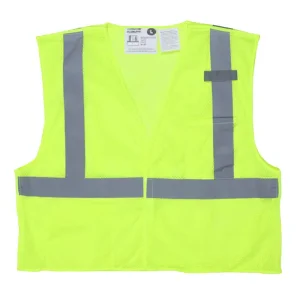
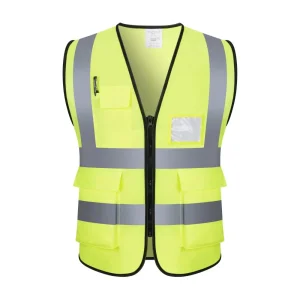
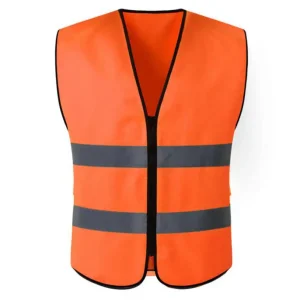
Global rail transport infrastructure is undergoing an unprecedented modernization push. As high-speed rail networks expand across Europe, Asia, and the Americas, alongside the heavy industrialization of freight corridors, track safety standards have shifted from basic compliance to multi-norm engineering. Railway environments present a unique combination of high-speed mechanical risks, electrical hazard zones, extreme weather variations, and micro-visibility challenges caused by dust, ambient light distortion, and nighttime operational shifts.
Within this complex operational environment, the China Rail Safety Vest Manufacturing Sector has evolved from basic OEM assembly lines into a sophisticated technological powerhouse. Modern Chinese PPE factories do not merely sew fabric; they integrate material science, optical photometric design, ergonomic pattern engineering, and automated ISO-certified quality assurance systems. Sourcing railway safety vests from top-tier Chinese manufacturers now grants global procurement directors access to cut-and-sew precision that directly satisfies stringent international mandates.
Technical Imperative: Unlike standard construction workwear, railway safety apparel requires specific chromaticity coordinates (fluorescent rail-orange within 595–605 nm wavelength), precise retroreflection photometric thresholds (RA > 500 cd/lx/m²), and obligatory anti-entanglement breakaway systems. Selecting a qualified Chinese manufacturing partner ensures these parameters are met consistently across large-scale procurement batches.
Navigating international tenders requires deep familiarity with localized regulatory standards. Professional Chinese factories manufacture to exact regional specifications:
| Standard Designation | Target Jurisdiction | Core Chromaticity & Retroreflective Requirements | Primary Railway Application |
|---|---|---|---|
| RIS-3279-TOM (formerly GO/RT 3279) | United Kingdom / Commonwealth Rail Networks | Mandatory Fluorescent Orange background fabric (spectral luminance factor ≥ 0.40). High retroreflective tape coverage. | Trackside engineers, signal operators, and maintenance crews operating adjacent to moving rolling stock. |
| ANSI/ISEA 107-2020 (Type R, Class 2 & 3) | United States, North & South America | Minimum 775 sq in (Class 2) or 1240 sq in (Class 3) background material with 201 sq in or 310 sq in of reflective tape. | Class I freight railways, commuter rail systems, and depot yard operations. |
| EN ISO 20471:2013+A1:2016 | European Union & International ISO Standard | 3-tier classification based on background fluorescent material and retroreflective tape surface area. Photometric stability after washing. | Trans-European rail corridors, metro systems, and light-rail construction projects. |
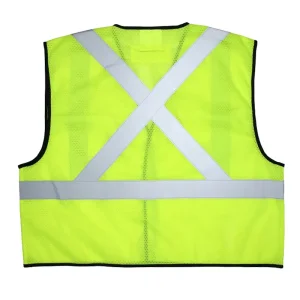
| CSA Z96 | Canada | Class 2 or 3 design featuring mandatory X-back retroreflective configuration for rear-approach visibility. | Canadian National and Canadian Pacific rail line work crews. |
A high-performance railway safety vest is an engineered personal protective garment designed to perform under severe mechanical stress and extreme environmental conditions. Leading manufacturers in Yongkang, Zhejiang—such as Yongkang Wow Safety Products Co., Ltd.—utilize cutting-edge textile chemistry and optical technologies to engineer vests that balance physical protection with wearer comfort.
Formulated with specialized azo-free fluorescent dyes that convert invisible ultra-violet radiation into high-luminance visible light. Engineered to resist UV degradation and maintain chromaticity limits even after 50+ industrial laundering cycles.
Incorporates Class 2 high-index micro-glass beads (RI > 1.93) or wide-angle micro-prismatic elements. Returns headlight beam signals directly back to train drivers at distances up to 300 meters, providing critical braking warning time.
Crucial anti-entanglement system featuring hook-and-loop closures at the shoulders, sides, and front zip. If caught by passing train components or moving machinery, the vest detaches instantly under 50 N of force, preventing worker dragging.
Constructed using 120–160 GSM 100% warp-knitted breathable polyester mesh. Delivers exceptional tensile and tear strength while facilitating rapid air exchange to reduce thermal heat stress during summer trackwork.
For rail workers near third-rail electrical grid infrastructure or overhead catenary cables, garments are treated with inherent or treated FR finishes meeting EN ISO 14116, ISO 11612, or ASTM F1506 standards.
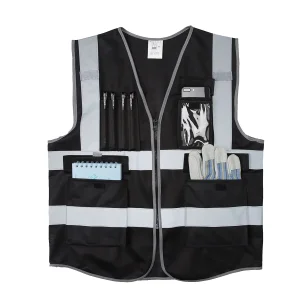
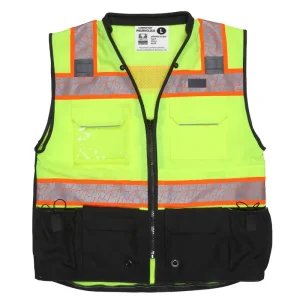
Tailored for track inspectors and signal technicians: includes clear TPU ID badge windows, heavy-duty mic/radio tabs, reinforced flashlight loops, dual pen slots, and tablet-sized lower cargo pockets with zipper seals.
B2B buyers, government transit procurement authorities, and safety equipment distributors face complex challenges when sourcing rail safety vests in bulk. Buying from China requires evaluating factory capabilities beyond basic pricing. Procurement officers must analyze quality management frameworks, factory audit compliance, production scalable capacity, and customization agility.
To ensure supply chain resilience and eliminate non-compliance liabilities in public tenders, buyers must audit Chinese suppliers against five core pillars:
Verify that test reports for retroreflectivity, colorfastness, and tensile strength originate from accredited third-party labs such as SGS, TÜV Rheinland, SATRA, or Intertek, rather than internal non-accredited reports.
Ensure the factory holds active ISO 9001:2015 Quality Management, ISO 14001 Environmental Management, and BSCI or SMETA social compliance credentials required for international public sector tenders.
Evaluate facility size, automated CAD cutting tables, automated sewing machinery, and monthly output metrics. Premium suppliers operate facilities over 6,000 m² with capacities exceeding 300,000 units per month.
Railway work encompasses diverse occupational roles, each demanding tailored high-visibility solutions. Leading Chinese manufacturers deliver specialized design configurations optimized for specific operational zones:
Requires lightweight, ultra-breathable RIS-3279-TOM compliant vests with aerodynamic flat-seam construction. High-velocity train bypass creates air pressure waves; 5-point breakaway closures prevent vest tearing or accidental drag.
High hazard density involving heavy moving machinery. Vests feature high-durability 300D Oxford polyester reinforcements at friction points, heavy-duty zipper fronts, and dual radio loops for constant communication.
Characterized by complete dark surroundings and artificial LED lighting. Micro-prismatic reflective tape configurations maximize 360-degree illumination under spotlight conditions, combined with moisture-wicking anti-microbial liners.
The future of rail safety apparel lies at the intersection of material sustainability and digital IoT integration. Chinese manufacturers are pioneering next-generation features that transform passive safety garments into active digital nodes within railway safety management systems.
Integration of ultra-thin, flexible LED light strips powered by rechargeable lithium-polymer micro-packs. Provides active illumination in zero-light tunnels independently of external light source retroreflection.
Embedded Ultra-Wideband (UWB) or RFID chips inside safety vest chest pockets that sync with trackside geofencing systems, alerting both train drivers and workers when personnel cross designated danger thresholds.
Transitioning to 100% GRS (Global Recycled Standard) certified recycled polyester fabrics synthesized from post-consumer plastic bottles, significantly lowering scope 3 carbon emissions for transit authorities.
Expert responses to critical questions regarding standards, OEM customization, sample lead times, and factory quality audits.
RIS-3279-TOM (UK Railway Standard) mandates fluorescent orange because green/yellow backgrounds can blend into natural countryside flora and foliage along railway tracks. Orange provides optical contrast against green environments and visual differentiation from yellow trackside signal equipment, ensuring train drivers spot workers rapidly.
Standard factory MOQ for custom-dyed fabrics or specific pocket layouts ranges from 500 to 1,000 units per style. However, for stocked certified fabrics (such as standard ANSI Class 2 lime or RIS-3279 orange mesh), smaller trial orders of 200–300 units can be accommodated for initial sampling.
Breakaway safety vests utilize 5-point hook-and-loop (velcro) connections along the shoulders, side seams, and front closure. If a worker's garment gets caught by moving machinery or passing rolling stock, the fasteners burst open under tension, freeing the worker from the garment and preventing dragging accidents.
Premium reflective tapes (such as 3M Scotchlite or top-grade Chinese equivalent glass-bead tapes) pass standard ISO 6330 washing tests for 25 to 50 domestic wash cycles at 60°C while maintaining retroreflective values above 100 cd/lx/m². Specialized industrial-wash tapes are available for up to 50+ commercial tunnel washes.
Following sample sign-off and lab dip approval, standard mass production lead time is 25 to 35 days. Express air freight sampling takes 5 to 7 days. Sea freight shipping from Ningbo or Shanghai port to major European or North American ports takes approximately 20 to 35 days.
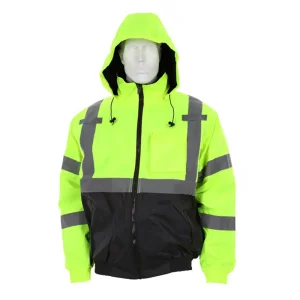
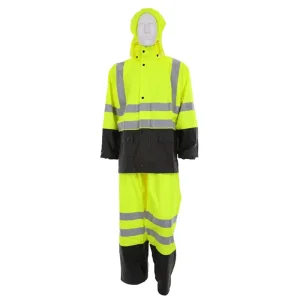
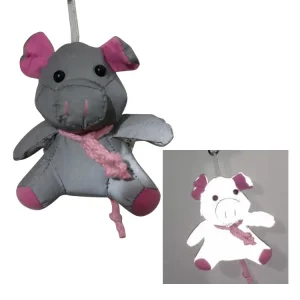
From waterproof weather jackets to EN ISO 20471 Class 3 winter parkas and reflective safety accessories.