Explore our factory-direct safety apparel catalog manufactured to strict ANSI/ISEA, EN ISO 20471, and AS/NZS compliance metrics.
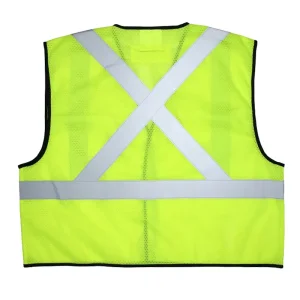
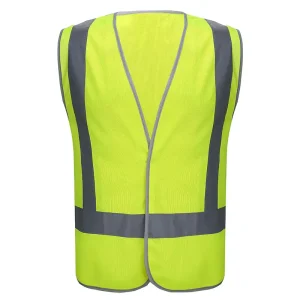
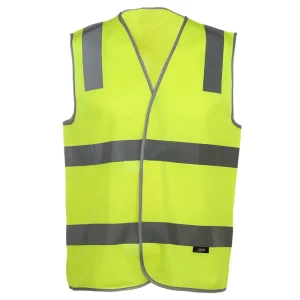
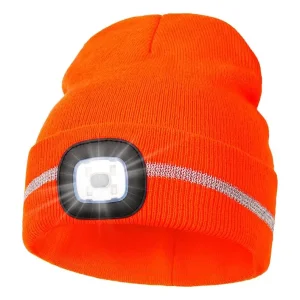
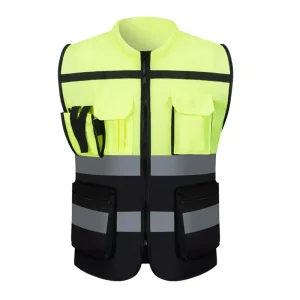
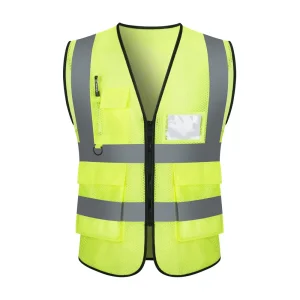
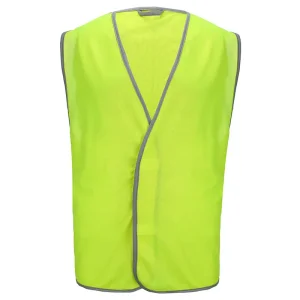
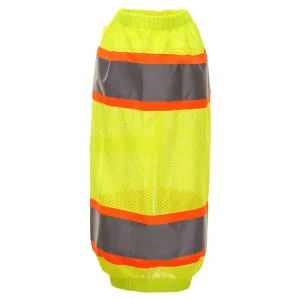
Understanding the transition from traditional heavy vests to single-layer high-visibility work shirts engineered for high-heat industrial environments.
Utilizing 130 GSM to 180 GSM 100% spun polyester birdseye mesh fabric. The micro-porous structure facilitates active thermal convection, permitting moisture transmission exceeding 0.18 g/cm²·h while keeping garment weight minimal.
Formulated with titanium dioxide ($TiO_2$) embedded directly into the synthetic polymer filaments during extrusion. Provides permanent UPF 30+ to UPF 50+ ultraviolet protection without fading after industrial laundering.
Dual-sided hydrophilic treatment draws perspiration away from the skin surface to the outer layer, where it spreads exponentially for rapid evaporation, lowering wearer core temperatures by up to 3°C.
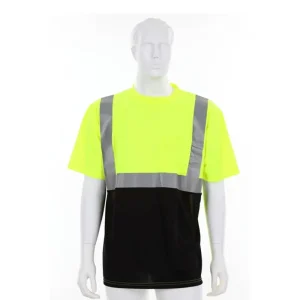
OEM Technical Insight: Traditional safety vest overlays worn over cotton T-shirts create thermal trap layers, increasing fatigue and heat-stroke risks for workers. Modern ANSI Class 2 and Class 3 Hi-Vis Work T-Shirts combine primary compliance fabrics and retroreflective tape into a unified, breathable single garment.
Navigating international regulatory frameworks: ANSI/ISEA 107-2020, EN ISO 20471:2013+A1:2016, and AS/NZS 1906.4:2010.
To achieve global market entry, Chinese manufacturers must align raw material formulation with precise chromaticity coordinates (measured under CIE D65 illuminant) and retroreflective luminance coefficients ($R_A$). Below is the technical compliance metric for enterprise work t-shirt procurement:
| Compliance Standard | Target Market | Min. Fluorescent Area | Min. Reflective Area | Photometric Target ($R_A$) | Verification Status |
|---|---|---|---|---|---|
| ANSI/ISEA 107-2020 Type R Class 2 | North America | 775 sq. in. ($0.50 \text{ m}^2$) | 201 sq. in. ($0.13 \text{ m}^2$) | $\ge 330 \text{ cd}/(\text{lx}\cdot\text{m}^2)$ | Third-Party Tested |
| ANSI/ISEA 107-2020 Type R Class 3 | North America | 1,240 sq. in. ($0.80 \text{ m}^2$) | 310 sq. in. ($0.20 \text{ m}^2$) | $\ge 330 \text{ cd}/(\text{lx}\cdot\text{m}^2)$ | Third-Party Tested |
| EN ISO 20471:2013 Class 2 | Europe & UK (UKCA) | $0.50 \text{ m}^2$ | $0.13 \text{ m}^2$ | $\ge 330 \text{ cd}/(\text{lx}\cdot\text{m}^2)$ | CE / UKCA Ready |
| EN ISO 20471:2013 Class 3 | Europe & UK (UKCA) | $0.80 \text{ m}^2$ | $0.20 \text{ m}^2$ | $\ge 330 \text{ cd}/(\text{lx}\cdot\text{m}^2)$ | CE / UKCA Ready |
| AS/NZS 1906.4:2010 / 4602.1 | Australia & New Zealand | Class F (W) Fluorescent | Class R Micro-prismatic | $\ge 400 \text{ cd}/(\text{lx}\cdot\text{m}^2)$ | NATA Lab Approved |
We utilize both 3M™ Scotchlite™ micro-glass bead technology for soft-flex compliance and micro-prismatic segmented heat-transfer film for maximum breathability during dynamic body movement.
Fluorescent Yellow-Green ($x=0.387, y=0.610$) and Fluorescent Orange-Red ($x=0.610, y=0.370$) fabrics are verified using Datacolor Spectrophotometers to prevent chromatic shift across dye lots.
Certified to sustain up to 50 ISO 6330 wash cycles at 40°C or 25 cycles at 60°C without reflective tape delamination or fabric luminescence degradation below threshold levels.
Why Yongkang and the Zhejiang textile cluster represent the global epicenter of high-volume, compliant safety garment production.
Located in Yongkang, Jinhua City, our production pipeline connects directly with local yarn spinning mills, dye houses, and reflective coating facilities. This localized ecosystem reduces raw material transit lead-time to under 48 hours.
Computerized layout nesting and automated multi-layer laser cutting guarantee dimensional tolerances within $\pm 1 \text{ mm}$. Eliminates manual cutting errors and maximizes fabric yield efficiency.
From greige cloth inspection to seam strength pull testing (ISO 13935-2) and retroreflective tape heat-bonding checks, our 4-stage inline QA guarantees zero-defect shipments.
Supply Chain Scale: Yongkang Wow Safety Products Co., Ltd. operates a 6,000 m² facility with 150+ skilled workers, producing over 300,000 certified safety garments per month to support global B2B procurement tenders.
Optimizing custom logo integration, chest pocket engineering, and private label branding without compromising garment certification.
Adding corporate branding (logos, team names, emergency badges) to high-visibility work shirts requires strict adherence to maximum allowed non-compliant surface areas. Excessive screen printing over fluorescent fabric can invalidate ANSI Class 2/3 or EN ISO 20471 compliance.
Logos must be calculated within the designated non-fluorescent allocation allowance. Safe zones include the left chest (max $10 \times 10 \text{ cm}$), upper sleeve sleeves, or back area situated outside retroreflective tape paths.
We offer breathable heat-transfer vinyl (HTV), soft-hand water-based silk screen printing, and micro-embroidered patches. Breathable segmented HTV is recommended to preserve shirt elasticity.
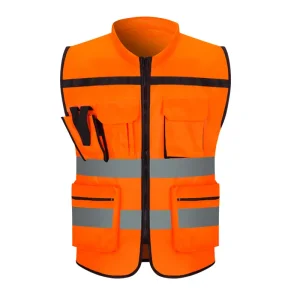
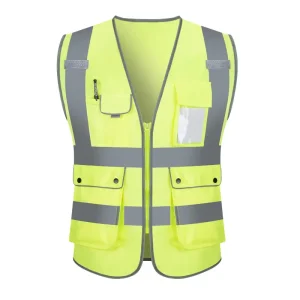
Reinforced chest pockets with dedicated pen slots and mic tabs. Pocket flaps are double-stitched with bar-tack reinforcement at tension points to withstand heavy field use.
Incorporating circular economy principles (rPET) and smart safety wearable tech into modern industrial apparel.
Global enterprise ESG requirements drive demand for GRS (Global Recycled Standard) certified polyester made from recycled post-consumer plastic bottles. Delivers identical tensile strength and fluorescent luminescence with 45% lower carbon footprint.
Moving away from solid continuous sewn reflective tape toward segmented chevron patterns. Enhances garment stretchability by 30% and improves breathability across the chest and back harness zones.
Embedding flexible washable RFID tags for industrial laundry asset tracking and integrating passive micro-LED active illumination arrays for zero-light subterranean and tunnel maintenance workers.
Selecting the right fabric GSM, colorway, and reflective tape configuration for specific high-risk operational environments.
Requirement: ANSI Class 3 or EN ISO 20471 Class 3.
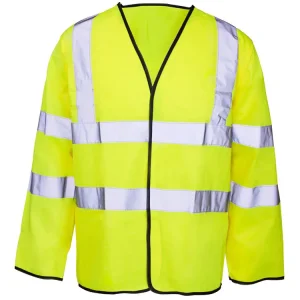
Solution: Long-sleeve Fluorescent Lime T-shirts with 360° vertical and horizontal reflective bands for vehicle speeds exceeding 50 mph.
Requirement: ANSI Class 2 Short Sleeve.
Solution: Lightweight 140 GSM birdseye moisture-wicking shirts with contrast black bottoms to conceal dirt and grease from equipment handling.
Requirement: High UV & High Wind Shear.
Solution: UPF 50+ Fluorescent Orange T-shirts with reinforced shoulder stitching and tear-away breakaway side seams for machine hazard safety.
Requirement: Anti-Static & Multi-Hazard.
Solution: Flame-Resistant (FR) blended cotton-polyester hi-vis work shirts compliant with NFPA 2112 and ASTM F1506 standards.
Direct technical answers for procurement officers, safety directors, and global importers.
Our standard MOQ for custom dyed fabric colors or specialized logo printing is 500 pieces per design/colorway. For standard stock fluorescent yellow or orange Birdseye knit fabric with custom heat-transfer branding, we can support trial procurement orders starting from 200 pieces.
We utilize Datacolor spectrophotometer analysis for every batch of dyed yarn and fabric. Lab dips are evaluated under D65, TL84, and CWF light sources to guarantee chromaticity values ($x, y$) strictly remain within the acceptable color ellipses specified by ANSI/ISEA 107 and EN ISO 20471.
Yes. However, the total surface area of non-compliant screen printing or embroidery must be factored into the overall garment square area calculations. Our design engineering team provides pre-production artwork proofs showing certified fluorescent area coverage to ensure compliance remains intact.
ANSI Class 2 garments require a minimum of 775 sq. in. of background fluorescent material and 201 sq. in. of retroreflective tape (typically short-sleeve designs). Class 3 garments require 1,240 sq. in. of background material and 310 sq. in. of reflective tape, requiring long-sleeve designs with reflective tape bands around the arms to provide full silhouette recognition in high-speed traffic zones.
Pre-production sample approval takes 3–5 business days. Mass production for standard volume orders (5,000–20,000 units) requires 20–25 days. Urgent procurement orders can be expedited via our automated cutting line workflow.
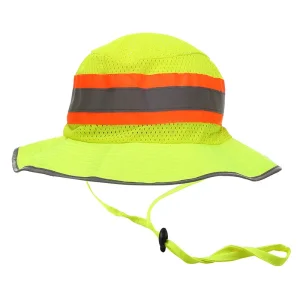
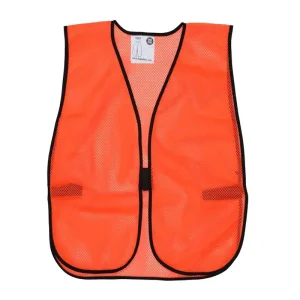
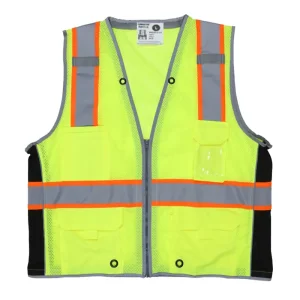
Browse additional factory products including heavy-duty vests, headwear, gaiters, and protective accessories.