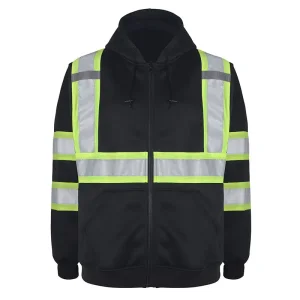
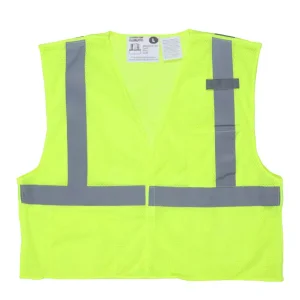
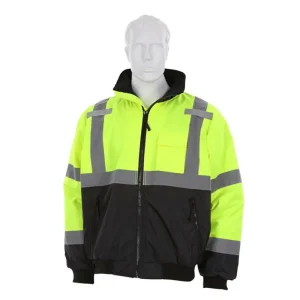
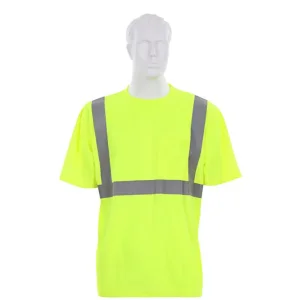
Explore our top-tier industrial safety gear certified for extreme weather protection, nighttime luminance, and occupational safety compliance.
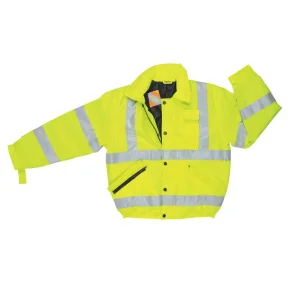
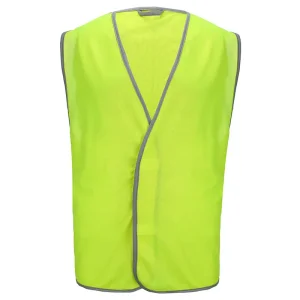
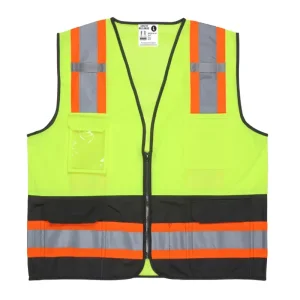
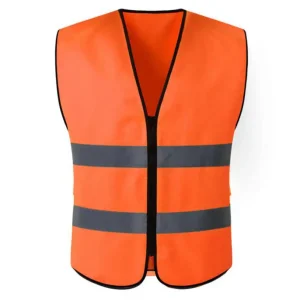
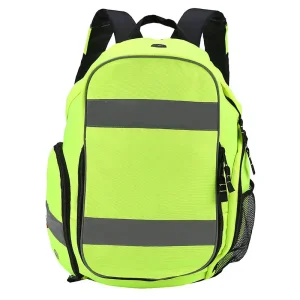
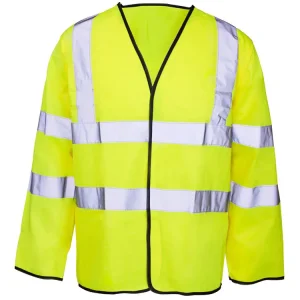
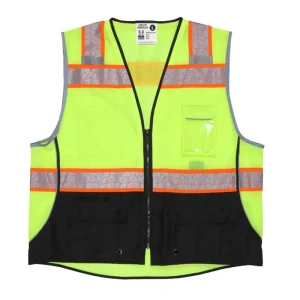
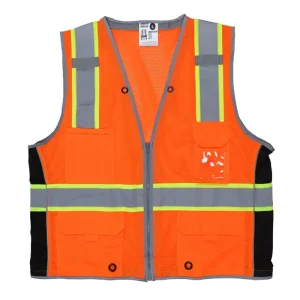
In the global Personal Protective Equipment (PPE) ecosystem, high visibility reflective jackets represent a critical line of defense for personnel operating in high-risk, low-luminance, and heavy-traffic environments. As infrastructure expansion, industrial automation, and stringent occupational health regulations accelerate worldwide, the global market for High-Visibility Safety Apparel (HVSA) is experiencing an unprecedented technical evolution.
China has consolidated its position as the premier manufacturing epicentre for reflective workwear, commanding over 65% of global output capacity. This dominance is not merely grounded in cost competitiveness; it is fueled by advanced textile engineering, vertical integration of retroreflective material synthesis, strict adherence to international safety standards (such as ANSI/ISEA 107-2020, EN ISO 20471:2013+A1, and AS/NZS 1906.4), and rapid OEM/ODM prototyping capabilities.
The industrial cluster model in Chinese manufacturing centers—specifically across Zhejiang, Jiangsu, and Shandong provinces—provides global buyers with unparalleled supply chain resilience and technical agility. Evaluating China's manufacturing capabilities reveals key competitive moats:
From raw PET resin polymerization to 300D Oxford weaving, TPU membrane lamination, and fluorescent dyeing, Chinese factories control the entire upstream fabric lifecycle, ensuring strict batch-to-batch color consistency and tear resistance.
Proprietary advancements in glass bead retroreflective coatings and micro-prismatic synthetic polymer films allow Chinese suppliers to offer retroreflectivity values exceeding 400 cd/(lx·m²), far outperforming standard baseline requirements.
Utilization of automated hot-air seam-sealing machinery ensures complete waterproof integrity across all jacket joints, eliminating water penetration at needle punctures under extreme hydrostatic pressure testing.
Navigating regional compliance is the paramount requirement for enterprise safety procurement. A high visibility jacket specified for highway maintenance in North America must satisfy different photometric and geometric parameters than one destined for European railway networks.
| Standard | Geographic Region | Classification Tiers | Min. Fluorescent Base Fabric | Min. Retroreflective Tape | Typical Applications |
|---|---|---|---|---|---|
| ANSI/ISEA 107-2020 | North America | Class 1, Class 2, Class 3, Type R/P/O | 0.80 m² (Class 3) | 0.20 m² (Class 3) | Highways, Airport Aprons, Construction |
| EN ISO 20471:2013 | European Union / UK | Class 1, Class 2, Class 3 | 0.80 m² (Class 3) | 0.20 m² (Class 3) | Railways, Emergency Response, Logistics |
| AS/NZS 1906.4:2010 | Australia / New Zealand | Class D, Class N, Class D/N | 0.40 m² (Class D/N) | 150 cm² (Class N) | Mining, Port Operations, Utilities |
| CSA Z96-15 | Canada | Class 1, Class 2, Class 3 (Level 1/2) | 0.80 m² (Class 3) | 0.20 m² (Class 3) | Oil & Gas, Municipal Infrastructure |
High visibility base fabrics rely on fluorescent dyes—Fluorescent Lime-Yellow, Fluorescent Orange-Red, and Fluorescent Red—that convert non-visible ultraviolet light wavelengths into visible light. To achieve certification, fabrics undergo strict spectrophotometric evaluations under daylight illuminant D65 to ensure chromaticity coordinates ($x, y$) remain within specified tolerance quadrangles both before and after Xenon arc light exposure testing.
The high-visibility jacket sector is experiencing rapid technological convergence. Leading China manufacturers are pioneering sustainable materials and active safety integration to redefine user protection:
Environmental, Social, and Governance (ESG) mandates are driving global buyers toward eco-friendly protective gear. Chinese suppliers are leading the transition by utilizing 100% Recycled Polyester (rPET) derived from post-consumer plastic bottles. Certified under the Global Recycled Standard (GRS), these fabrics achieve equal tensile strength, color fastness, and water-repellency while reducing carbon footprints by up to 45%.
Passive retroreflectivity relies entirely on external light sources (e.g., vehicle headlights). To protect workers in total darkness or dense smoke environments, modern jackets integrate active electroluminescent (EL) strips or flexible LED piping powered by rechargeable lithium polymer battery packs, guaranteeing 360-degree visibility over 500 meters without external illumination.
As global regulations phase out per- and polyfluoroalkyl substances (PFAS), advanced factories in China have transitioned to C0 Fluorocarbon-Free Durable Water Repellent (DWR) chemistry. These environmentally conscious treatments offer oil and water repellency while complying with EU REACH and US EPA restrictions.
For enterprise fleet managers handling thousands of uniforms, high-vis jackets are now embedded with washable RFID/NFC microchips. This enables automated laundering tracking, life-cycle inspection logging, and employee authorization verification across secure industrial facilities.
High visibility jackets must be engineered to withstand micro-climates, mechanical abrasion, and specific chemical exposure depending on the operational environment:
Requires ANSI Class 3 / EN ISO Class 3 compliance with continuous 360° retroreflective banding around sleeves and torso. Features include heavy-duty breakaway zippers to prevent entanglement with moving machinery.
Demands anti-static carbon fiber grid integration (EN 1149-5) paired with inherent Flame Retardant (FR) modacrylic/cotton fabrics certified to EN ISO 11612 and NFPA 2112 standards.
Incorporates multi-layer thermal insulation (3M Thinsulate or 200gsm quilted fleece) combined with breathable TPU membranes (MVP > 5,000 g/m²/24h) to prevent sweat condensation during heavy manual labor in freezing conditions.
When evaluating high visibility jacket manufacturers in China, international enterprise buyers must establish rigorous vendor auditing protocols. Below is the standard B2B quality control verification framework:
Answer: The primary differentiator lies in the square area of background fluorescent fabric and retroreflective tape. ANSI Class 2 requires a minimum of 775 sq. in. of background fabric and 201 sq. in. of reflective tape, suitable for traffic speeds under 25 mph. ANSI Class 3 requires at least 1,240 sq. in. of background material and 310 sq. in. of reflective tape, incorporating full sleeves with reflective banding. Class 3 is mandatory for high-risk workers on high-speed roadways (exceeding 50 mph) or under extreme weather conditions.
Answer: Leading Chinese manufacturers utilize high-grade glass microbead heat-transfer film or micro-prismatic PVC/TPU tapes bonded via precise temperature, pressure, and time parameters during hot-stamping. Base fabrics are pre-treated with hydrophobic hydrophobic primers. Garments undergo ISO 6330 wash testing (at 40°C to 60°C) to ensure the coefficient of retroreflection ($R'$) remains well above 100 cd/(lx·m²) even after 25 to 50 wash cycles.
Answer: Yes. However, logo placement must follow certification guidelines. Printing oversized logos over retroreflective tape or replacing significant areas of fluorescent base fabric can render the jacket non-compliant. Chinese OEM factories provide technical layout digital proofs, utilizing flame-retardant silk screen printing or heat-transfer films placed in designated "non-critical" zones (e.g., chest pockets or back shoulders) to preserve full ANSI or EN ISO certification validity.
Answer: The industry standard for heavy-duty waterproof outerwear is 300D (Denier) Polyester Oxford fabric with a backside PU (Polyurethane) or TPU membrane coating. For breathability during physical exertion, microporous TPU coatings (offering 10,000mm waterproofing and 5,000 g/m²/24h water vapor permeability) are specified alongside fully taped seams.
Answer: Standard OEM order MOQs typically range from 500 to 1,000 units per style for customized fabric colors and specialized reflective strip designs. For stock-supported standard models, MOQs can be as low as 100 units. Prototyping and custom sampling require 7–10 days, while full bulk production ranges between 25 and 40 days depending on fabric dye lot lead times and order volume.
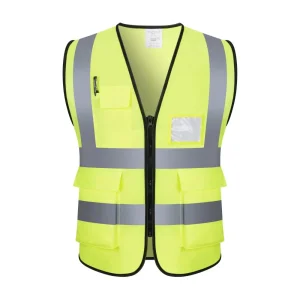
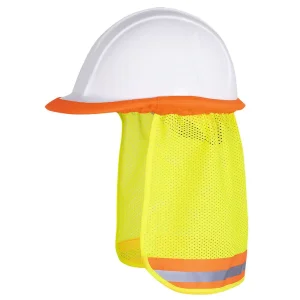
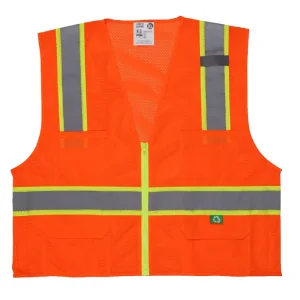
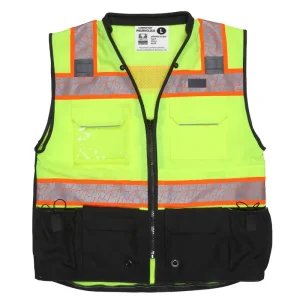
Complete high visibility solutions including sweatshirts, multi-pocket surveyor vests, and protective headwear shields.