Explore our top-certified safety apparel portfolio engineered for global industrial infrastructure, logistics, and high-risk operations.
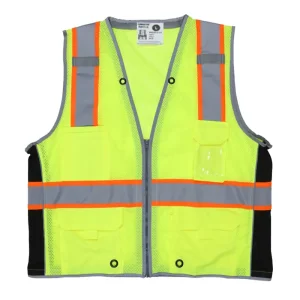
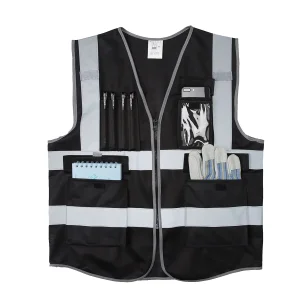
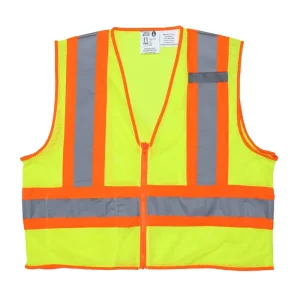
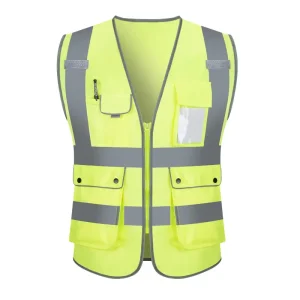
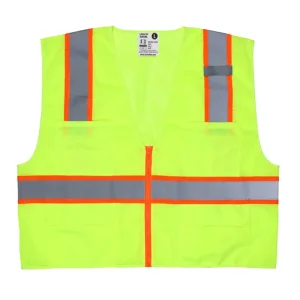
Understanding regional occupational safety mandates, microclimate performance demands, and supply chain strategies driving high-visibility shirt adoption.
In the evolving landscape of global industrial Personal Protective Equipment (PPE), the transition from traditional, heavy-duty safety vests toward ergonomic, moisture-wicking Hi Vis Reflective T-Shirts represents a major paradigm shift. Procurement directors across North America, Europe, Australia, and the Middle East are restructuring their annual safety apparel contracts to prioritize worker compliance, thermal regulation, and multi-standard protection.
Governments worldwide enforce strict high-visibility standards to mitigate struck-by hazards. In North America, ANSI/ISEA 107-2020 governs Class 2 and Class 3 garments; in Europe, EN ISO 20471:2013+A1:2016 enforces strict photometric performance; and in Australia/New Zealand, AS/NZS 1906.4 / 4602.1 requires specialized daytime fluorescent and nighttime retroreflective properties.
Workplace heat stress is a major cause of occupational injury. Modern Hi Vis Reflective T-Shirts engineered by specialized Chinese factories utilize advanced 100% polyester birdseye mesh, moisture-wicking interlock weaves, and UPF 50+ UV-blocking treatments to ensure breathability and rapid evaporative cooling under intense heat.
B2B buyers evaluate apparel longevity over simple unit pricing. High-quality reflective T-shirts manufactured with heat-applied segmented reflective tape endure 25 to 50+ industrial wash cycles without losing retroreflective performance ($R_A \ge 330 \text{ cd}/(\text{lx}\cdot\text{m}^2)$), maximizing replacement cycles and ROI.
Unlike basic safety vests worn over casual clothing, integrated high-visibility T-shirts reduce total garment layers, decreasing heat stress index (WBGT) by up to 18% in ambient temperatures exceeding 32°C (89.6°F), while ensuring baseline compliant fluorescent coverage at all times.
In-depth technical breakdown of fabric weights, retroreflective glass bead vs. microprismatic media, and moisture management systems.
| Specification Parameter | Standard Range / Material | Performance Standard | Industrial Application Impact |
|---|---|---|---|
| Base Fabric Weight | 130 GSM - 180 GSM Birdseye Mesh / Interlock | ISO 3801 / ASTM D3776 | Optimizes tear strength while maintaining breathability. |
| Fluorescent Chromaticity | Fluorescent Yellow-Green, Fluorescent Orange-Red | EN ISO 20471 Clause 5.1 / ANSI Class 2 & 3 | Ensures high contrast visibility under natural daylight & twilight. |
| Reflective Tape Type | Segmented Heat Transfer Film / Glass Bead Sew-on | Retroreflective Coefficient $R_A > 330 \text{ cd}/(\text{lx}\cdot\text{m}^2)$ | Segmented design grants 30% greater stretch and ventilation. |
| Moisture Wicking Rate | Capillary Action Hydrophilic Finish | AATCC 195 / ISO 13029 | Accelerates sweat absorption and rapid drying. |
| UV Protection Factor | UPF 30+ to UPF 50+ Treatment | AS/NZS 4399 / ASTM D6603 | Protects outdoor workers from solar ultraviolet radiation. |
| Industrial Wash Durability | 25x - 50x Home/Industrial Wash @ 60°C | ISO 6330 / ISO 15797 | Prevents cracking, peeling, and reflectivity drop over time. |
Leading Chinese manufacturers leverage high-tenacity filament polyester combined with micro-denier yarns. The bird-eye knit structure creates thousands of micro-apertures per square meter, promoting dynamic airflow during movement without compromising fabric opacity or compliance surface area requirements.
Traditional solid reflective strips restrict fabric stretch and trap heat against the body. Advanced heat-applied segmented reflective tape utilizes pattern gaps (typically 2mm-5mm) that flex dynamically with the polyester matrix, significantly enhancing freedom of motion while preserving 360-degree reflectivity.
How end-to-end supply chain integration delivers quality, scalability, and strict international compliance.
Computer-controlled automatic cutting tables ensure sub-millimeter precision across all shirt components. This minimizes fabric waste and ensures that fluorescent background area thresholds strictly meet EN ISO 20471 / ANSI Class standards across sizes S to 5XL.
Digital heat-seal machinery regulates temperature, pressure, and dwell time down to micro-tolerances. This precise thermal bonding prevents reflective tape delamination during high-temperature commercial laundry cycles.
Every production batch undergoes 100% inspection for seam strength, retroreflection index, color fastness to light/rubbing, and logo placement alignment, ensuring zero-defect export shipments.
Specifying exact safety features according to specific operational environments and occupational hazards.
Requires ANSI/ISEA 107 Class 3 / EN ISO 20471 Class 3 compliance with full 360-degree retroreflective coverage. Short and long-sleeve Hi-Vis T-shirts with combined body and arm reflective bands maximize detection distances for high-speed traffic zones.
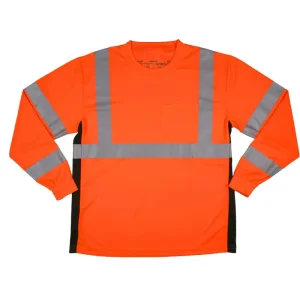
Focuses on lightweight ANSI Class 2 shirts with black-bottom panel designs. The dark lower hem resists dirt, grease, and abrasion from forklift operations while keeping the upper torso brightly visible.
Demands high contrast colors (Fluorescent Yellow paired with reflective strips) plus integrated radio loops and ID badge pockets. Anti-static fiber blends prevent electrostatic spark discharge near fueling ops.
Requires Flame Resistant (FR) treatments complying with NFPA 70E / EN ISO 11612. Modacrylic cotton blend Hi-Vis T-shirts protect electrical and wind-turbine technicians against arc flash hazards.
Integrating recycled polymers, smart LED passive elements, and eco-friendly dye chemistry into OEM workwear.
Transitioning to GRS (Global Recycled Standard) certified recycled PET post-consumer plastic bottles. rPET Hi-Vis shirts deliver identical tensile strength, color vibrancy, and UV protection while lowering carbon footprint by up to 30%.
Emerging hybrid garments combine passive retroreflective tapes with active, flexible electroluminescent (EL) or ultra-thin micro-LED light strips powered by rechargeable lithium-ion packs, enhancing visibility in pitch-black zero-light conditions.
Adopting waterless supercritical CO2 dyeing methods and bio-based auxiliary agents to eliminate hazardous wastewater discharge, ensuring full compliance with REACH and OEKO-TEX Standard 100 protocols.
Expert answers regarding standard compliance, custom OEM capabilities, wash testing, and bulk ordering procedures.
From heavy-duty insulated jackets to rainwear and safety accessories — complete certified protection from one manufacturer.
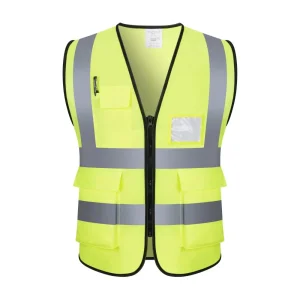
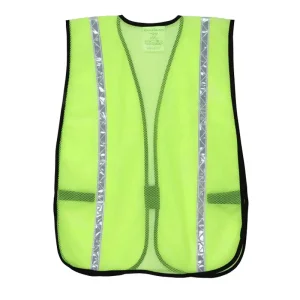
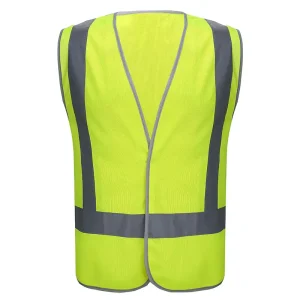
Get direct factory pricing, tech specification sheets, free sample swatches, and custom OEM/ODM branding solutions tailored to ANSI, EN ISO, and AS/NZS standards.