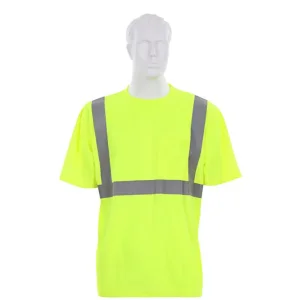
Certified OEM/ODM solutions tailored for global construction, infrastructure, and industrial safety compliance.
Deploying High-Visibility Safety Apparel (HVSA) mapped precisely to operational threat profiles and optical environment variables.
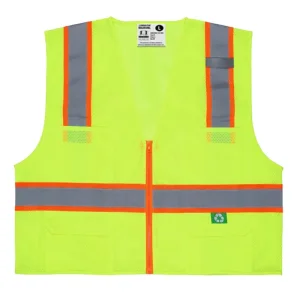
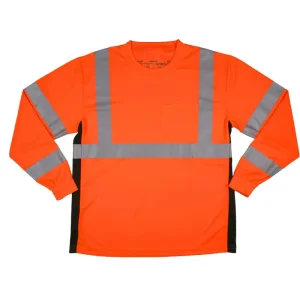
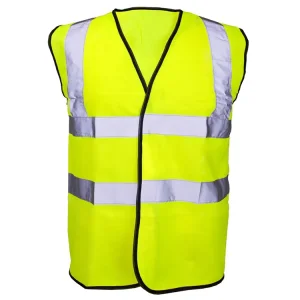
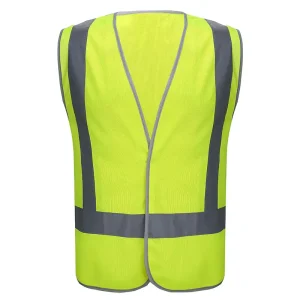
High-speed highway construction environments require maximum photopic contrast. Our ANSI Class 3 and EN ISO 20471 Class 3 reflective vests integrate micro-prismatic tape rated at >500 cd/(lx·m²), granting motorists 360-degree detection at distances exceeding 300 meters under night-time low-beam headlights.
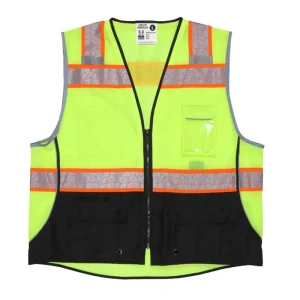
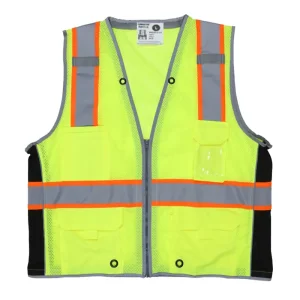
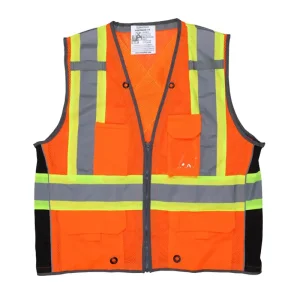
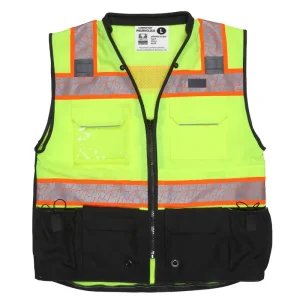
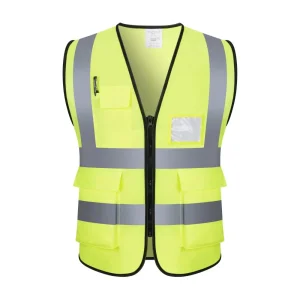
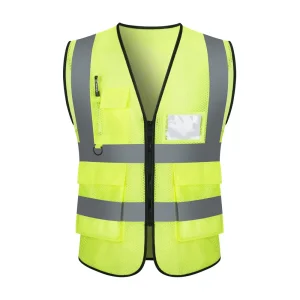
Engineered specifically for site engineers and surveyors requiring high tool utility. Featuring 6-to-9 multi-functional reinforced pockets, tablet/iPad dimensions, dual mic tabs, heavy-duty non-conductive zippers, and 300D breathable Oxford mesh to prevent thermal stress during prolonged field audits.
For oil, gas, and electrical utility work, standard polyester vests present thermal ignition hazards. We manufacture inherently flame-retardant (FR) Modacrylic/Cotton blend safety vests compliant with NFPA 70E Arc Flash Category 2 and ISO 11612 standard specifications.
Understanding retroreflection coefficients, fluorescent luminance factors, and polymer durability in demanding physical operations.
High-visibility safety relies on sending vehicle headlight rays directly back to the driver's focal axis (retroreflection). China's leading manufacturing facilities utilize two primary technical routes:
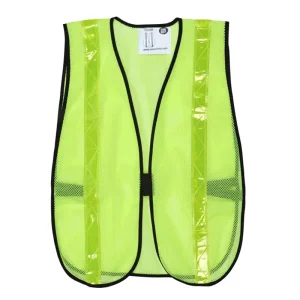
1. High-Index Micro-Glass Sphere Technology: Utilizing microscopic glass beads (refractive index $n \ge 1.90$) embedded in a metallic silver vacuum layer. Delivers smooth wide-angle performance, optimal for general Class 2 waistcoats.
2. Micro-Prismatic Vinyl/TPU Technology: Uses precision-molded cube-corner prisms to maximize coefficient of luminous intensity ($R_A \ge 500\text{ cd/lx}\cdot\text{m}^2$). Highly superior under torrential rainfall conditions (EN ISO 20471 wet-performance tested).
Fluorescence convert invisible ultraviolet radiation into visible daylight spectrum wavelength. Factory dye processes require precise colorimetry within CIE Chromaticity Coordinates:
• Fluorescent Yellow-Green: Highest human scotopic & photopic sensitivity ($y \ge 0.388$). Preferred for heavy equipment construction zones.
• Fluorescent Orange-Red: Optimal contrast against green foliage and maritime/coastal horizons ($y \le 0.390$).
Our fabric formulations integrate UV-stabilizer additives preventing premature pigment degradation under solar ultraviolet exposure (retaining color fastness level 4+ after 100 hours of xenon arc exposure).
| Performance Parameter | Standard Commercial Grade | Industrial Grade (Wow Safety Standard) | Testing Protocol Compliance |
|---|---|---|---|
| Retroreflectivity ($R_A$) Initial | 150 - 250 cd/(lx·m²) | > 380 - 500 cd/(lx·m²) | ANSI/ISEA 107 Section 9.1 / ISO 20471 |
| Domestic Wash Durability | 15 to 25 Wash Cycles | 50 to 75 Wash Cycles @ 60°C | ISO 6330 Method 6N / AATCC 135 |
| Fabric Tensile Strength | < 400 N | ≥ 650 N Warp / 550 N Weft | ISO 13934-1 / ASTM D5034 |
| Tear Resistance (Ripstop) | 15 N | ≥ 28 N (Reinforced Oxford) | ISO 13937-2 |
| Environmental Safety | Basic AZO Free | OEKO-TEX 100 Class I / REACH Compliant | EU Regulation (EC) No 1907/2006 |
How Zhejiang & Yongkang industrial clusters deliver unmatched scalability, cost control, and rapid lead-time optimization.
Within the Yongkang safety manufacturing hub, raw polyester resin spinning, fabric weaving, fluorescent dyeing, reflective film laminating, and robotic pattern cutting operate within a localized 50 km radius—eliminating bottleneck transit times and drastically reducing total manufacturing overhead.
Utilizing multi-ply automated CNC laser cutting tables guarantees precision margin tolerances within ±0.5 mm. Digital pattern nesting software maximizes fabric yield, reducing material waste by up to 14% and transferring direct unit cost savings to B2B procurement partners.
Implementing ISO 9001 quality management combined with automated spectroradiometer inspections ensures every fabric roll matches target L*a*b color coordinates prior to stitching. Finished products undergo strict AQL 1.5/4.0 sampling before container loading.
By partnering with direct China manufacturers, global distributors eliminate 20-35% middleman markups. With daily production outputs exceeding 40,000 units of safety vests, custom private label OEM orders are typically completed with standard 15-25 day lead times, backed by FOB, CIF, or DDP delivery options.
Navigating international personal protective equipment (PPE) directives across North America, Europe, Australia, and regional procurement authorities.
Categorizes HVSA garments into Type & Class structures based on work environment risk profile:
• Type R (Roadway): Class 2 requires minimum 775 in² background fabric & 201 in² retroreflective tape. Class 3 requires 1,240 in² background & 310 in² tape with full torso/arm sleeve coverage.
• Type O (Off-Roadway): Class 1 designed for warehouse & parking attendant applications.
• Type P (Public Safety): Specialized for first responders and law enforcement with quick breakaway capability.
Mandatory CE mark standard across Europe establishing strict geometric design rules:
• Class 3 Garments: Must cover torso and include either long sleeves or full-length trousers with reflective bands encircling limbs.
• Photometric Test Requirements: Includes retroreflection after abrasion, flexing, folding at cold temperatures, rainfall exposure, and dry-cleaning cycles.
• Chemical Safety: Compliance with EU REACH regulation prohibiting harmful azo dyes, phthalates, and heavy metals.
Specifies strict high-visibility requirements for high-risk Australian climates:
• Class D/N (Day/Night): Combines fluorescent luminescent material for daytime visibility with retroreflective tape layout in 'H' or 'X' patterns on back for night protection.
• UV Protection factor (UPF): Outer fabrics tested to UPF 50+ standards to guard workers against extreme solar radiation exposure.
Canadian workplace safety standard dictating harness-style stripe configurations:
• Requires an 'X' pattern on the back of vest extending from shoulders to waist, alongside horizontal waist bands and two vertical front stripes.
• Class 2 & Class 3 garments are rigorously verified for brightness retaining properties in sub-zero ambient environments (-30°C flex testing).
The evolution of high-visibility workwear toward active illumination, IoT sensor integration, and 100% circular recycled textiles.
Passive retroreflective tape relies on external light sources. Next-generation smart vests incorporate integrated flexible LED light guides powered by rechargeable micro-lithium battery packs, providing active self-luminescence visibility even in pitch-black environments without vehicle headlamps.
Embedding ultra-lightweight Bluetooth Low Energy (BLE) or LoRaWAN beacons into vest lining enables automated site roll-calls, real-time geofencing warnings near heavy machinery, and instant man-down/accelerometer fall detection alerts sent to site safety supervisors.
Leading China manufacturers are shifting to Global Recycled Standard (GRS) certified 100% recycled post-consumer PET bottles (rPET). Utilizing bio-based fluorescent dyes drastically reduces carbon footprint while maintaining identical color fastness and optical brilliance.
A structured evaluation matrix for procurement officers, enterprise buyers, and safety supply distributors.
Sourcing ultra-cheap non-certified vests often leads to rapid retroreflectivity loss after 5-10 domestic washes, resulting in non-compliance fines and mandatory replacement expenses.
TCO Calculation Model:
$\text{Cost per Wash Cycle} = \frac{\text{Initial Garment Price + Freight Cost}}{\text{Certified Wash Longevity Cycles}}$
By procuring industrial-grade vests with 50+ wash cycle certification, enterprise buyers achieve a 38% lower annual wear-and-tear replacement cost over a 24-month site deployment cycle.
Before awarding manufacturing tenders, ensure supplier compliance with key social & technical standards:
• Social Responsibility Audits: BSCI (Business Social Compliance Initiative), SMETA / Sedex 4-Pillar audit report certification.
• Technical Audits: In-house spectrophotometer color testing, darkroom photometric retroreflective measurement, and tensile seam strength testing equipment.
• OEM Customization: Silk-screen printing, thermal transfer printing, heat-seal reflective branding, and custom Pantone dye matching.
Expert answers regarding standards, minimum order quantities (MOQ), custom branding, and quality control protocol.
The primary distinction lies in the surface area of fluorescent background fabric and retroreflective tape, as well as the garment design layout. ANSI Class 2 requires a minimum of 775 square inches of background fabric and 201 square inches of reflective tape (ideal for traffic speeds under 25-50 mph). ANSI Class 3 requires 1,240 square inches of background fabric and 310 square inches of reflective tape, while requiring full torso coverage with sleeves or trousers (mandatory for high-speed roadway zones exceeding 50 mph).
Reputable Chinese factories work directly with accredited international testing bodies such as SATRA, TÜV Rheinland, SGS, and Centexbel. Pre-production fabric lots are evaluated for color coordinates under illuminant D65, luminance factor ($\beta$), color fastness to washing/perspiration, and photometric reflectivity of retroreflective tape both before and after conditioning cycles. Full CE certification certificates and EU Declaration of Conformity (DoC) documents are supplied for customs verification.
Yes, logo printing is standard practice for corporate identification. However, standards like ANSI/ISEA 107 and EN ISO 20471 dictate maximum allowable logo surface area. If a logo covers too much background fluorescent material, the total compliant visible surface area may drop below mandatory class thresholds. Professional manufacturers calculate logo placement dimensions on the back or chest pocket to maintain full certification integrity.
For standard stock fluorescent fabrics (Lime/Yellow and Orange), factory MOQs typically start at 500 to 1,000 pieces per design with custom logo screen printing. Custom fabric colors or special FR treatments may require 3,000 pieces. Digital pre-production samples are generally produced within 3-5 business days, while full container production runs require 15 to 25 calendar days depending on seasonal peak capacity.
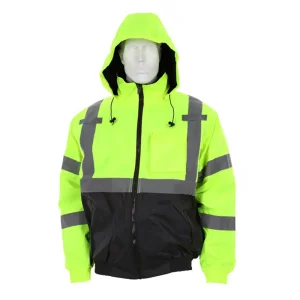
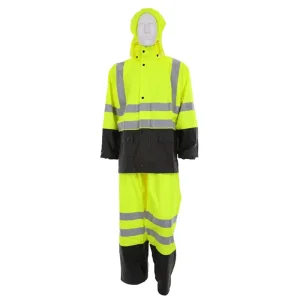
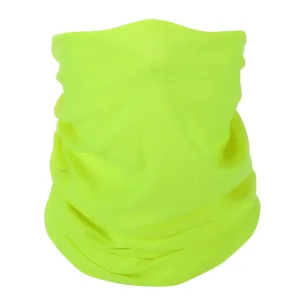
Explore rainwear, multi-pocket surveyor vests, cooling neck gaiters, and specialized Class 2/3 workwear apparel.