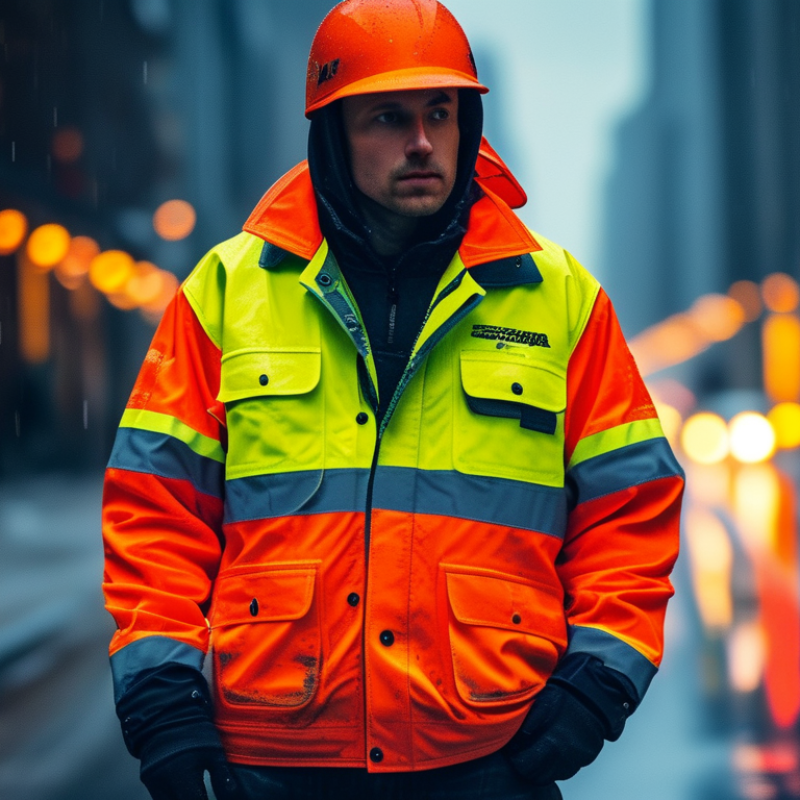
Choosing the right Hi Vis Jacket is more than selecting a bright color. It is a decision about visibility, movement, weather protection, and daily work conditions.
Workwear safety specialist Mark Saner explains, “Visibility is only useful when the garment remains visible in real working conditions.” That point matters on a rainy road, beside moving vehicles, or beneath weak winter light. A jacket should match the risk, not merely look fluorescent. Check the reflective tape width, placement, contrast, and certification details. EN ISO 20471 and ANSI/ISEA 107 provide useful reference points, but requirements can differ by region and workplace.
Start with the environment. A road worker may need waterproof fabric, vertical reflective bands, and a longer cut. A warehouse employee might value lighter material, breathable panels, and easy arm movement. Inspect the jacket after repeated washing. Faded fabric, cracked tape, or loose stitching can quietly reduce performance. Small details matter.
Fit matters too.
A jacket that hangs loosely may catch on equipment. One that fits tightly can restrict layering and movement. Consider pockets, hood adjustment, cuff closures, and ventilation before buying. These features sound minor, yet they shape real use during long shifts.
There is no perfect jacket for every worker. That is worth admitting. Product descriptions can also feel reassuring while hiding practical weaknesses. Compare the manufacturer’s technical data with the actual workplace hazard assessment. The safest choice is the one that remains visible, comfortable, and functional throughout the entire shift.
How to Choose the Right Hi Vis Jacket?
Visibility standards matter more than bright color alone. The U.S. Bureau of Labor Statistics reported 1,942 fatal occupational injuries from transportation incidents in 2023. That risk increases near moving vehicles, especially during darkness, rain, or glare. A suitable jacket should match the work zone, traffic speed, and lighting conditions.
ANSI/ISEA 107-2020 identifies Type O for off-road use, Type R for roadway work, and Type P for public safety. It also defines performance classes based on visible material and design. For road crews, Class 2 or Class 3 may be appropriate, but the site risk assessment should decide. Class 3 provides the greatest visibility. In Europe and many international projects, EN ISO 20471 uses Classes 1 through 3. Requirements differ, so check the contract and local safety rules.
Look for fluorescent yellow, orange, or red material during daylight. Retroreflective bands should outline the torso, arms, and shoulders at night. The jacket must fit over winter layers without covering the reflective tape. Wet fabric, mud, and worn tape reduce performance. Clean it according to the care label. Replace it when color fades or reflective areas crack. I once underestimated fit. A loose sleeve can hide a tape band during movement. Small detail. A useful jacket is not merely bright; it remains visible while the worker bends, turns, and works.
| Selection Factor | ANSI/ISEA 107 Framework | EN ISO 20471 Framework | Practical Jacket Guidance |
|---|---|---|---|
| Primary purpose | Defines performance requirements for high-visibility safety apparel and accessories used in the United States and other markets that recognize this standard. | Defines high-visibility clothing requirements used throughout Europe and in other markets that adopt the standard. | Choose the standard required by the worksite, employer, contract, or local regulation. ANSI and EN classifications should not be treated as automatically equivalent. |
| Risk environment | The standard considers the work environment, traffic exposure, garment configuration, and the need for visibility during daytime and nighttime conditions. | The required class is selected according to the level of risk, traffic speed, distance from moving vehicles, and the need to identify the wearer clearly. | Higher vehicle speeds, complex backgrounds, poor weather, and closer proximity to traffic generally require a higher visibility level. |
| ANSI garment type | Type O: intended for off-road use where the wearer is not exposed to roadway traffic. Type R: intended for roadway or temporary traffic-control environments. Type P: intended for public safety activities such as emergency response. |
EN ISO 20471 primarily classifies garments by visibility performance rather than using the ANSI Type O, R, and P system. | For roadside work, select a jacket specifically marked for roadway use rather than an off-road-only garment. |
| ANSI Class 1 | The lowest ANSI visibility level. It is intended for lower-risk situations where the wearer is well separated from traffic and vehicles move slowly. | There is no direct one-to-one conversion between ANSI Class 1 and EN ISO 20471 classes. | Use only when the risk assessment permits a lower level of visibility, such as some off-road or low-speed environments. |
| ANSI Class 2 | Provides an intermediate level of visibility and is commonly used where workers are exposed to roadway traffic, moving equipment, or changing backgrounds. | Not directly equivalent to EN ISO Class 2. Each standard uses its own design, material-area, and placement requirements. | A suitable starting point for many roadwork, construction, utility, warehouse, and logistics tasks when a higher level is not required. |
| ANSI Class 3 | The highest ANSI visibility class. It is designed to provide conspicuity through the torso and additional body coverage, such as sleeves or trouser legs. | Not directly equivalent to EN ISO Class 3, although both represent their respective standards' highest garment visibility class. | Choose when workers face fast-moving traffic, poor visibility, complex backgrounds, or a high risk of not being seen in time. |
| ANSI Class E supplemental garments | Supplemental garments, such as high-visibility trousers, bib overalls, or gaiters. When worn with an appropriate Type O, R, or P garment, the combined ensemble may achieve a higher classification. | EN ISO 20471 evaluates the garment or certified ensemble according to its own requirements; ANSI Class E terminology does not apply. | Check the complete outfit, not only the jacket. Adding trousers can improve lower-body recognition and may be required for the work activity. |
| EN ISO Class 1 | No direct ANSI equivalent. | The lowest EN ISO 20471 visibility class, intended for lower-risk situations where traffic exposure and vehicle speed are limited. | Use only where a documented risk assessment confirms that the lowest class is acceptable. |
| EN ISO Class 2 | No direct ANSI equivalent. | An intermediate visibility class for work near traffic or mobile equipment where the wearer must be clearly identified in daytime and low-light conditions. | Often appropriate for general construction, transport, maintenance, and industrial work, subject to local requirements. |
| EN ISO Class 3 | No direct ANSI equivalent. | The highest EN ISO 20471 visibility class, requiring extensive coverage and design features intended to make the wearer conspicuous from all directions. | Select for high-risk work near fast traffic, on motorways, in poor weather, or where maximum conspicuity is required. |
| Fluorescent background material | Fluorescent material improves daytime visibility by converting ultraviolet light into visible light. Common permitted colors include fluorescent yellow-green and fluorescent orange-red, subject to the standard and garment certification. | Fluorescent material is used to improve daytime and overcast-condition visibility. Approved colors and color-performance requirements are defined by the standard. | Choose a background color that contrasts strongly with the worksite. Orange-red can provide useful contrast in green vegetation, while yellow-green is highly conspicuous in many urban and industrial settings. |
| Retroreflective material | Returns light toward its source, helping drivers and equipment operators recognize the wearer in darkness or when illuminated by headlights. | Must meet specified retroreflective performance, design, and placement requirements for the certified visibility class. | Look for continuous or clearly positioned bands around the torso and, where applicable, the sleeves. Check that the bands remain visible when the jacket is fastened or layered. |
| Contrast and body recognition | Design requirements support recognition of the human form, particularly the torso and, for higher classes, the limbs. | The design and placement of background and retroreflective materials help distinguish the wearer from the surrounding environment. | Prefer jackets with visible front, back, and side coverage. Avoid placing tools, bags, or harnesses over large areas of reflective material. |
| Weather protection | ANSI/ISEA 107 visibility classification does not by itself guarantee waterproofing, breathability, insulation, or protection from cold. | EN ISO 20471 visibility classification does not replace separate requirements for waterproofness, thermal protection, or other protective functions. | For rain, select a jacket with a separately stated waterproof or water-resistant performance. For cold conditions, consider insulation, layering, and freedom of movement. |
| Fit and coverage | The garment must be worn as designed to maintain the required visibility area and configuration. | The certified class depends on the approved garment design, material areas, and configuration. | Choose a size that allows required layers without covering reflective bands. Sleeves, zippers, closures, and hoods should not significantly reduce visibility. |
| Maintenance and service life | Dirt, abrasion, fading, chemical exposure, and repeated laundering can reduce visibility performance. Follow the garment care instructions. | The same practical risks apply. The garment should be removed from service when fluorescent or retroreflective materials are excessively worn, damaged, contaminated, or faded. | Inspect regularly, wash according to the label, avoid unauthorized alterations, and replace the jacket when visibility is visibly degraded. |
| What to verify before purchase | Confirm the label identifies the applicable ANSI/ISEA 107 type and class, along with any relevant garment or ensemble information. | Confirm the garment is marked for EN ISO 20471 and shows the applicable class and required conformity information for the market. | Check the standard edition, class, garment type, size range, weather features, care instructions, and whether the complete outfit satisfies the employer's risk assessment. |
How to Choose the Right Hi Vis Jacket?
Choosing a hi vis jacket starts with the workplace hazard, not the color. Map moving vehicles, machinery, blind corners, and escape routes before selecting clothing. A worker beside a slow forklift may face different risks from a road crew near fast traffic. Lighting matters too. Rain, dust, darkness, and vehicle glare can reduce contrast quickly. The U.S. Bureau of Labor Statistics recorded 5,283 fatal occupational injuries in 2023. Transportation incidents remained a leading category, according to its Census of Fatal Occupational Injuries report.
Visibility must match the working environment. ANSI/ISEA 107-2020 separates garments into Classes 1, 2, and 3. Class 1 suits low-risk areas with slow-moving vehicles and clear separation. Class 2 provides more body coverage for roadwork, parking areas, and moderate traffic. Class 3 offers the highest visibility, including added sleeves and stronger recognition in complex backgrounds. ISO 20471 uses performance classes and also evaluates background material, retroreflective material, and design. Check the required standard.
Fit is part of hazard control. A loose jacket can catch on equipment. A tight jacket may hide reflective areas when workers bend or reach. Sleeves should remain visible during normal tasks. Keep reflective bands clean and unobstructed. Mud can quietly defeat good design. One uncomfortable truth deserves attention: bright clothing cannot replace lighting, barriers, training, or a safe traffic plan. Reassess after seasonal changes, night shifts, or new machinery arrive. A jacket selected from habit may look compliant, yet fail the actual worksite.
Assess workplace hazards, traffic speed, worker exposure and required visibility levels before selecting a garment.
The chart uses the three ANSI/ISEA 107 garment performance classes as a practical visibility scale: Class 1 for lower-risk environments, Class 2 for traffic or equipment exposure, and Class 3 for high-risk conditions such as poor visibility, high-speed traffic or complex backgrounds.
This is a general assessment guide, not a substitute for a site-specific hazard assessment or applicable legal requirements. Always check local regulations and the current ANSI/ISEA 107 standard before purchasing workwear.
Choosing the right hi vis jacket starts with its material, fit, and weather protection. Polyester is lightweight, durable, and dries quickly after light rain. For colder work, a layered jacket with insulated lining holds warmth better. Breathable fabric matters when climbing stairs or carrying equipment, because trapped sweat can make you feel colder later. Reflective bands should remain visible from the front, back, and sides.
Fit affects both safety and comfort. The jacket should cover your waist when reaching overhead, but it must not hang loosely near machinery. Try it over your usual work layers. Check the shoulders, cuffs, and zipper movement. A jacket that feels perfect over a shirt may become tight over a fleece. I have made that mistake before. Roomy does not always mean practical.
Tips: Match protection to the forecast. Choose a waterproof outer layer for steady rain and sealed cuffs for windy conditions. In mild weather, ventilation under the arms can prevent overheating. Inspect the reflective areas regularly, especially after washing. Dirt and wear may reduce visibility sooner than expected. Select closures you can operate with gloves, and avoid pockets that interfere with harnesses or tools. Weather ratings can guide you, but real comfort also depends on activity level, layering, and local conditions.
A hi vis jacket should support movement, not restrict it. During long shifts, I check the shoulder cut, sleeve shape, and side ventilation first. A jacket can look highly visible yet feel stiff after several hours. That matters when climbing steps, reaching across shelves, or operating equipment. Choose adjustable cuffs and a hem that stays secure without pressing your waist. Soft lining also helps during repeated daily wear. However, thicker insulation is not always better. It may create heat and slow your movements.
Tips: Bend, reach, and raise your arms before buying. Test every zipper with gloves on. Check whether the reflective areas remain visible when the jacket is partly open. Look for breathable panels if your work involves frequent walking. For wet conditions, examine the hood, seams, and water-resistant fabric carefully. A removable hood can improve visibility and reduce neck pressure. Small details make a real difference.
For daily work, select features that match your actual routine. Multiple pockets are useful, but oversized pockets may catch on handles or ladders. Interior pockets can protect phones from rain and impact.
Lightweight designs often improve comfort, though they may provide less warmth. I sometimes choose a simpler jacket and regret losing one secure pocket. That mistake reminded me to compare practical access with appearance. Check care instructions too, because poor washing habits can reduce reflective performance and fabric life.
How to Choose the Right Hi Vis Jacket?
Checking Jacket Care, Durability, and Long-Term Compliance
A high-visibility jacket should remain bright after repeated washing, outdoor work, and heavy use. Check the care label before buying. It should clearly state washing temperature, drying method, and restrictions on bleach or ironing. Cold water may protect fabric, but it does not remove every workplace contaminant. That is something many users learn too late. Use a suitable detergent and inspect the jacket after each wash.
Durability appears in small details. Examine the stitching around pockets, cuffs, shoulders, and zipper ends. Reflective strips should lie flat, without peeling edges or deep cracks. Hold the jacket toward a strong light and look for thinning fabric. I once noticed a worn sleeve only after several weeks of rain. The jacket still looked acceptable from a distance, but its protection was already weakening. Comfort also matters, because workers may avoid wearing stiff or poorly ventilated clothing.
Long-term compliance requires regular records, not assumptions. Note the purchase date, cleaning frequency, repairs, and inspection results. Compare the garment’s markings and performance claims with the visibility requirements used in your workplace. Requirements can differ by task, location, and risk level. Replace the jacket when colors fade, reflective areas deteriorate, or seams fail. Small repairs may extend service life, but they cannot restore damaged visibility. Do not ignore uncomfortable warning signs. A jacket can appear clean while no longer providing dependable recognition in traffic, poor weather, or low light.
Polyester is lightweight, durable, and dries quickly after light rain. It suits active shifts and repeated outdoor use. It is not a complete solution for steady rain.
It should cover your waist when you reach overhead. The shoulders and sleeves should move without pulling. Avoid loose fabric near machinery. Try it over your usual work layers.
Breathable fabric helps release sweat while climbing stairs or carrying equipment. Trapped moisture can make you feel colder later. Small detail, big effect.
Reflective bands should remain visible from the front, back, and sides. Inspect them after washing and heavy use. Dirt, peeling edges, and cracks can reduce recognition.
Bend, reach, and raise both arms. Test the zipper while wearing gloves. Check shoulder movement, cuffs, hem security, and side ventilation. A shirt fit may feel tight over fleece.
Choose a waterproof outer layer for steady rain. Sealed cuffs help block wind. Examine the hood, seams, and water-resistant fabric carefully. A removable hood may reduce neck pressure.
Not always. Oversized pockets may catch on ladders, handles, or tools. Thick insulation can create heat and restrict movement. Interior pockets can protect phones from rain and impact.
Read the care label before washing. Follow temperature, drying, and ironing instructions. Inspect stitching around pockets, cuffs, shoulders, and zippers. Record cleaning, repairs, and inspection results.
Replace it when colors fade, reflective areas deteriorate, or seams fail. Small repairs cannot restore damaged visibility. I once noticed a worn sleeve too late. The jacket looked fine from a distance.
Choosing the right Hi Vis Jacket begins with understanding safety standards and visibility classes. Select a jacket that matches the risks of your work environment, such as vehicle traffic, low light, bad weather, or reduced visibility. Higher visibility levels may be necessary for workers near roads, construction areas, or moving equipment. Consider the jacket’s material, fit, and weather protection to ensure it remains comfortable and practical throughout the workday. Breathable fabrics can help in warm conditions, while waterproof and insulated designs offer better protection in cold or wet weather.
When comparing jackets, look for features that support comfort, mobility, and daily work needs, including adjustable cuffs, secure pockets, flexible panels, and easy-to-use closures. A good jacket should allow natural movement without being too loose or restrictive. Finally, check care instructions, fabric strength, reflective strip durability, and resistance to frequent washing. Regular maintenance helps preserve visibility and extend the jacket’s service life, supporting continued compliance with workplace safety requirements.